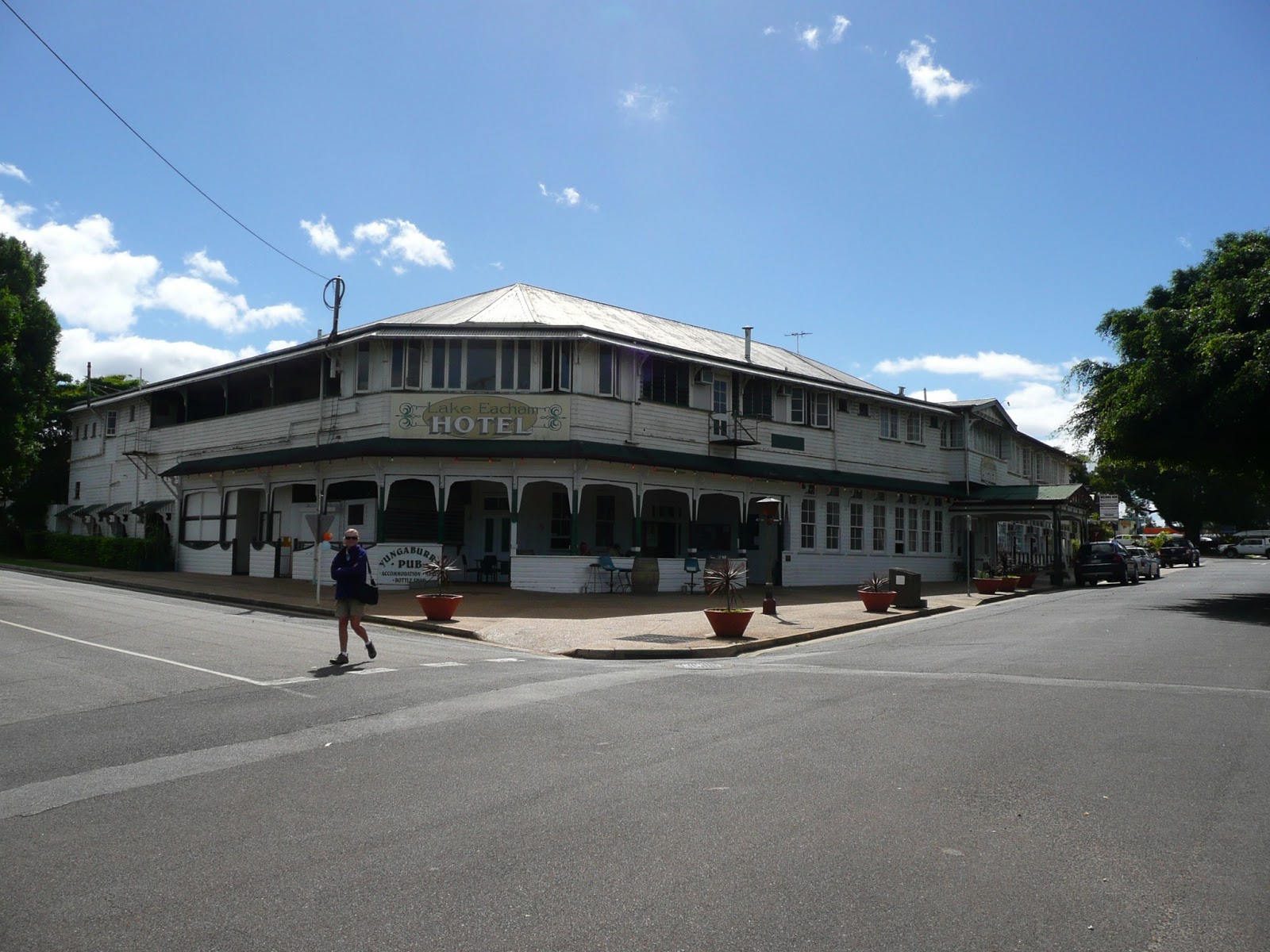
Both the township of Herberton, and, more particularly, the Herberton Historic Village, had been recommended to us as, to quote those puerile TV ads for a new show, a 'Must See'. As usual, my approach was one of sceptical hesitance, particularly when confronted with the Historical Village entry fee of $26 and the information that the exit could only be achieved through the café and souvenir shop.
Four hours later I was prepared to confess unashamedly that this was the best $26 I had invested for some time. What an extraordinary place, and what difficulty I am having culling the mass of photos I took to be able to present an overview that does not run to many pages. In making that comment, I must add that I strongly suspect the village holds much more attraction for the over 60's than for the younger generation. The school, for example, was a nostalgic paradise for those of us who can still actually calculate in LSD (no, not the psychedelic variety)!
This astounding collection of Australiana is housed on sixteen acres of reclaimed virgin bushland on the outskirts of Herberton Town some 20 kms from Atherton. Comprising over fifty buildings and untold numbers of items ranging from antique furniture to old steam engines and vehicles, this microcosm of the past owes it existence to the single-minded dedication of Harry Skennar and his wife.
Harry, a Tableland lad, began collecting when he was six. His passion continued unabated until his death in 2009 at the age of 75. How he had time to also become an Australian wood-chopping champion is anyone's guess. Harry's motto of, "You can't throw it away, that's history", has certainly resulted in what is reckoned to be the best collection of its kind in the country.
Harry, a Tableland lad, began collecting when he was six. His passion continued unabated until his death in 2009 at the age of 75. How he had time to also become an Australian wood-chopping champion is anyone's guess. Harry's motto of, "You can't throw it away, that's history", has certainly resulted in what is reckoned to be the best collection of its kind in the country.

Beginning in 1973, all but one of the buildings, the Tin Pannikin Pub, have been transported to the site from elsewhere, and some of those journeys were tortuous indeed. The old Herberton school, pictured here on site,
very nearly came to grief as it was being transported on the barely discernible low loader down the steep main street hill out of Herberton Town.

But let us begin our tour, with the editorial note that the morsels presented are very much subjective as far as their selection is concerned (I have to confess to a limited interest in traction engines and the like) and the comment that I have relied heavily on photos to speak for themselves.

This poor attempt at providing an overview of the village represents about a quarter of all that is on offer but hopefully give some flavour.

Visitors are provided with site maps and encouraged to wander as they choose. We began at the pub, named the Tin Pannikin Pub in recognition of the tin mining which gave Herberton its existence, but actually built to replicate that famous establishment of Ken Maynard's 'Ned and his Neddy' cartoon fame, the redoubtable Ettamogah Pub (in the land where the crows did fly backwards with their boots on).

I was delighted to find a sign on the wall of the pub which was just so much in keeping with what I well remember of the Maynard sense of humour.

Through the bar room and on up the stairway at the end of the room and we found ourselves on the upper balcony off which a doorway led to

the drunk's room, where, according to the sign on the door, those of significantly unsteady feet would be housed for the night rather than let them wander off into the clutches of the local villains or the constabulary. One can but wonder as to what the knowledge of the existence of this room did for the thirst of patrons!
And of course, what self respecting country pub would not provide a bridal suite?

Finding this gem of hotel luxury directly above the main bar reminded me of the yarn which tells of the country honeymooners who were perplexed by the fact that roars of acclamation from the bar below greeted each of their acts of newly married passion. It was not until the next morning they realised that a rope, which passed through a hole in the floor (read bar-room ceiling) and ended in a bell, had been attached to the underside of their bed. Could it possibly be true.....I would love to think so! The Aussie version of the Italian white sheet trick.
 Moving on. As we walked the few steps to the school building we passed one of the bark slab structures in the village, this one housing the pub's outdoor cooking area. I was struck by the incongruity of the modern fire extinguisher!
From the pub to the school room, where the classroom set up took me immediately back to my primary school days where we sat on tilting bench seats at wooden, lift top desks complete with ink wells and pen grooves, trying to determine, on occasions, which was the more distracting....the promise of lunch time or the desire for a cushion. But what a joy it was to read some of the chalked educational offerings.

How I would love to drag some of our modern day journalists and other assorted scribes to ingest this lesson, both the grammar and the expressed rationale.
And just how many of our current third graders do you think could pass this test (even

assuming they were aware that there were 12 pence to the shilling and 20 shillings to the pound....told you I could remember LSD)?
The school building also housed an odd mixture of other exhibits where, for example, old dental and medical equipment rubbed shoulders with a military exhibition which could only be described as 'different'. Mind you, the sight of this pulley and string driven dental drill did again transport me to my youth, evoking memories of treatments I am happy to have forgotten (isn't it a wonderful human trait that we cannot actually reconstruct pain in our minds)

The military exhibits did throw up one surprise in the badge section with a small

reminder of home.
 From the school house we wandered into the shed containing a wide array of horse-drawn vehicles of all descriptions, with the old penny farthing cycle thrown in for good measure. Apart from the general interest created by this exhibit, there were two in particular which caught my attention.
 I can clearly recall the outside loo which was a feature of our house in Port Lincoln (where I spent the first eight years of my life) complete with its wooden seat and removable contents drum. They were fun, these outside dunnies. A rolled up newspaper (and, of course, at night a torch) was a mandatory requirement of any trip .....to deal with the red-back spiders which housed themselves in this outdoor facility in considerable numbers. The absence of connected sewerage or a septic tank provided a wonderful job opportunity for some....the dreaded 'night cart men', always clearly identifiable by their specific leather shoulder shawls onto which they would hoist the brimming dunny drums only to replace them with an empty unit (there were other ways of knowing who engaged in this employment!) And, here in Herberton, was a stark reminder of those days, including empty drums atop the cart.
And just to complete the picture for those of you who have never experienced the thrill of the arachnid wars in an outside dunny, this is what they looked like. Don't you just love the smell of phenol!?

The need for rear access (I possibly could have worded that better) to these facilities is the reason for the small lanes to be found running behind the properties in many of our older suburbs. And, of course, there is that wonderful Australian word 'dunny'. According to the good folk of Herberton, this is a derivation of the English word 'dunnikin' or 'dung house'.
And whilst on the subject of Aussie slang, another example was on display in this section. Rather than my words, a photo of the relevant plaque...

and a typical cart itself.

Our walk through time next logically took us to the old motor vehicle pavilion. Here, I must confess, my enthusiasm was limited, but a couple of the exhibits did catch my eye. What a place to find the very Morris Cowley Van used in that extraordinarily popular TV show, 'The Sullivans', but here is was.


And one just for my old mate, Winky, who, with his lovely wife Michelle, is growing old disgracefully on his beloved Harley. Well, this is how they began life, and I can assure you, when this village employee fired it up, there was no doubt it was a Harley, albeit one which misfired a tad.

On and on we strolled, through street after street, all of which brought new surprises,
including this sign. To what it actually relates we have no idea, but we were taken by the simplicity of its message!

We could not help wondering if any foolish soul had actually treated this like a 'wet paint' sign!
 The extraordinary range of products in the grocer's store (of which these pictured are but a small sample) brought back many memories,
 whilst these two exhibits in the overwhelming range of old bottles on display
brought with them yet another completely unexpected touch of home. As an aside, you will note the rounded base of this bottle. This was copied from the original Irish 'torpedo' bottle, so designed to ensure that its cork always remained moist (with the distinct side effect of potentially totally confounding those in their cups after they had poured a round!)
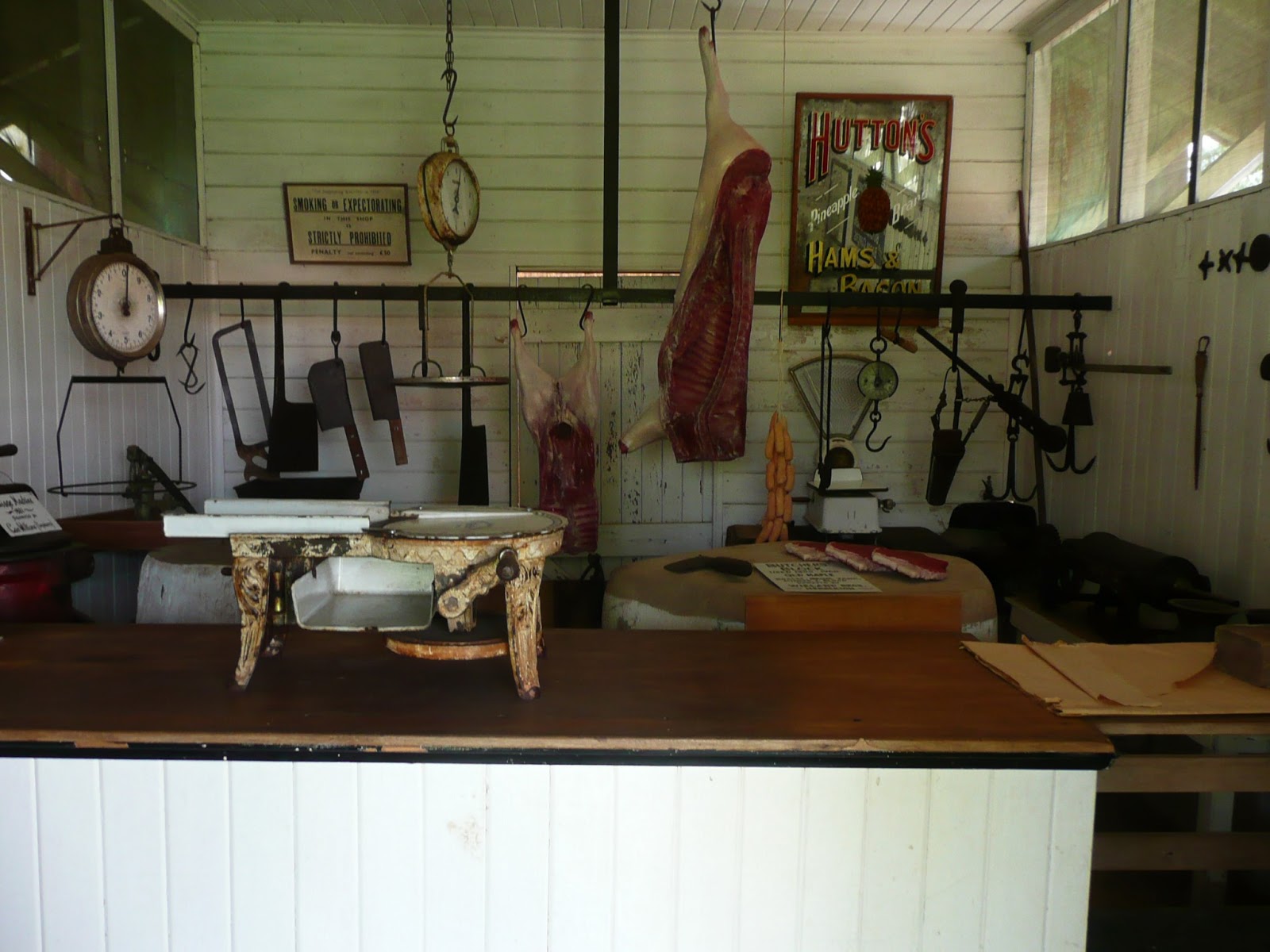
And here's one just for you, Tom Keogh.
The old pharmacy store was an absolute picture of colourful bottles, jar after jar of medicinal ingredients, and all sorts of other odds and ends.

In fact this was, for us, one of the highlight exhibitions in the village, of which this shot shows but a third.

One of the oldest buildings in the village, this slab hut, c1860, was originally built on the vast Glen Dhu cattle station where it served first as the stockmen's quarters and later the station temporary homestead.


A close look at this building leaves no doubt that those who settled this vast land of ours did not do so in the lap of luxury.
The same could be said for the miner's hut, the old lock up buildings (which also houses a large array of old weapons), and many others which formed the various streetscapes of this captivating village.
So, with one final look at yet another of these streets

let us make our way out of the village itself, and across the Wild River suspension bridge

to the reconstructed pioneer camp set up on the opposite bank, where, in a sad (but acceptably necessary) commercial grab, damper and billy tea is on offer for those prepared to part with some significant coin of the realm.

Neither of us drink tea and so we avoided a moral dilemma at the Pioneer Camp, but we did salve our consciences by 'taking luncheon' in the village pub (the operating one that is, and in name only....it is really tea rooms)

where the highlight of an indescribable collection of bric-a-brac was this extensive display of silverware. (Liz didn't know where to look!)

With all that I have presented in this offering, I have not included the bank, the frock salon, the toy shop, the telephone exchange, the jewellery store, the boot-maker, the newsagent, the camera store, the farmers' store and many others. This village is almost overwhelming in its scope, and, as I stated previously, represents one of the best 'value for money' experiences we have had. I must add, as a postscript, that we did manage to emerge from the souvenir exit shop empty-handed.
With the historic village under our belts, the real township of Herberton beckoned before we made our way back to Lake Tinaroo. And here we were still up to our armpits in history.
Herberton, which was established as a result of the discovery of a rich lode of tin in 1880, and was the first town on the Tableland, still boasts some of its oldest buildings.
Herberton, which was established as a result of the discovery of a rich lode of tin in 1880, and was the first town on the Tableland, still boasts some of its oldest buildings.

As the road into the township so amply demonstrates, Herberton is a hilly (and on the day of our visit, very damp) place, but one of great charm. The bridge pictured here at the bottom of the slope is the very spot where the Herberton school nearly came to grief as it was being transported to the historic village, and frankly, little wonder.

The short main street, here seen looking to the east, and

The short main street, here seen looking to the east, and
here to the west,


is home to buildings which include the oldest building on the Tableland, the Arts Centre, (which we found somewhat underwhelming)

the new post office, complete with its stained glass windows designed and manufactured by the post master's wife, (which he was only too happy to allow us to photograph)

and the Shire Offices.
The normal collection of businesses, the supermarket, take-away, and so on were all housed in wooden buildings of some age, but there was one exception.

After a double take, we realised that the 'modern', quite nondescript, purple building which, in this streetscape, stood out like a pimple on a pumpkin, was a pub (we firstly mistook it for the local deli). And, as can be clearly seen, it could not be located any more closely to its far more imposing rival. Talk about 'little and large'. We had no time to explore this more closely and left wondering about this licencing oddity.
At the eastern end of the main street lies the original post office, pictured here

with the town's simple but elegantly sited war memorial in the background. To us this building epitomised Herberton more than any other, which,

as can be seen in this shot, remains doggedly rustic.
But one of many surprises is this wonderful mural which tells the story (in some detail..warts and all...unusually it includes facts about the less than charitable treatment of the local aborigines at the hands of white settlers) of the development of Herberton.

And all this beautiful art work seemingly just plonked on the wall of one of the lesser buildings in the street!
The Spy Camera Museum (what else would you expect to find in an old township like this...by all accounts it is very good) and the equally renowned Mining Museum were beyond us on this visit. After the historic village, we were 'museumed out'. They will just have to await our return visit.
As is undoubtedly obvious, the weather during our visit to Herberton was overcast, drizzly and generally dank, but strangely we found this quite in keeping with the steep, forest clad, almost brooding mountainous country in which this historical gem is nestled, and about which I have banged of for more than enough. We had a great day, and, as every primary school 'composition' of my era about 'a day at the beach' would conclude, "we returned home tired but happy" (I'm still sitting in the Herberton schoolroom!)
Let me conclude with a final editor's note (apart from yet another apology for some of the presentation of this blog...my programme is in dizzyland).
In real time we have now been at Lake Tinaroo for almost two weeks. Tomorrow we move to Kurrimine Beach for three. Obviously in the time we have been here on the Tableland I have acquired much more to tell. This I intend to do whilst we are at Kurrimine where we spent time last year (we are actually returning to the same site) and about which I do not intend to bore you with a repetition. So more of Atherton, our trip to Cairns and some social snippets to come over the next week.
PS Just to cheer you all up, the news that the weather here is still bloody awful....almost constant rain/drizzle and wind for the past ten days. Could almost be in Adelaide except for the temperature....and joy of joys, I have just been listening to a local climatology professor who is predicting a La Nina winter for northern Qld....WET!!
The Spy Camera Museum (what else would you expect to find in an old township like this...by all accounts it is very good) and the equally renowned Mining Museum were beyond us on this visit. After the historic village, we were 'museumed out'. They will just have to await our return visit.
As is undoubtedly obvious, the weather during our visit to Herberton was overcast, drizzly and generally dank, but strangely we found this quite in keeping with the steep, forest clad, almost brooding mountainous country in which this historical gem is nestled, and about which I have banged of for more than enough. We had a great day, and, as every primary school 'composition' of my era about 'a day at the beach' would conclude, "we returned home tired but happy" (I'm still sitting in the Herberton schoolroom!)
Let me conclude with a final editor's note (apart from yet another apology for some of the presentation of this blog...my programme is in dizzyland).
In real time we have now been at Lake Tinaroo for almost two weeks. Tomorrow we move to Kurrimine Beach for three. Obviously in the time we have been here on the Tableland I have acquired much more to tell. This I intend to do whilst we are at Kurrimine where we spent time last year (we are actually returning to the same site) and about which I do not intend to bore you with a repetition. So more of Atherton, our trip to Cairns and some social snippets to come over the next week.
PS Just to cheer you all up, the news that the weather here is still bloody awful....almost constant rain/drizzle and wind for the past ten days. Could almost be in Adelaide except for the temperature....and joy of joys, I have just been listening to a local climatology professor who is predicting a La Nina winter for northern Qld....WET!!