Wednesday, 4 October 2017

WE HEAD OFF TO THE HEADS - BURNETT HEADS THAT IS (24 - 26 AUGUST 2017)

The Biloela morning dawned chilly and damp. Tendrils of mist were writhing across the paddocks at the far end of the park, and, as I began to prepare for our departure, I saw movement in the distance.


A mob of kangaroos was out and about, no doubt seeking out a tasty green morsel or two for breakfast but as I watched it was clear that two had other things on their minds.


These big males were hard at it and this bout lasted for quite some time. I remain unsure as to whether or not this was merely a morning warm up exercise or the real thing, but which ever it was there was no doubt that neither of them would have been cold for long.


Whilst this boxing match was entertaining me (and a few others who joined me at the fence with camera in hand), Liz took the opportunity to entertain the Black Panther. We had another fairly long day ahead of us and Max is always a much more amenable travelling companion if he has had a morning stroll which includes a toilet break. I am sure any watching would be utterly confounded by the joy a peeing cat can evoke in two otherwise normal looking adults!


Hitched and ready to go, we again hove to as the massive park gates slowly and ponderously swung open as if reluctant to see the last of us.


But leave we must, and with one last look at the most impressive water tower, gleaming white above the office in the early morning light, 


we took to the highway once again, this time on the Dawson which would carry us to the Bruce Highway just beyond Calliope.


I mentioned previously that hay production is big around Biloela, and this paddock of lush lucern which we passed just as we cleared the town outskirts was another fine example.


The irrigated paddocks soon gave way to the open grazing fields with yet another mountain ridge ahead of us. We were still making our way through various stretches of the Great Dividing Range and knew that the flat road on which we were now travelling would not last for too long.


Never a truer word spoken....the morning sun was still quite low as we headed into 'them thar hills',


bade farewell to the Banana Shire, and crossed the boundary into the Gladstone Region.


The highway continued to wind its way through cuttings and up and down some quite steep inclines, 


from which, every so often, we were afforded spectacular views across the valleys to the next haze shrouded ridge beyond.


Hang on, what's this? We almost take extensive roadworks on the Bruce Highway for granted, but here on the Dawson? Get used to it folks......


.....this was but the first of series of major works we encountered over the next 30 kms or so, each involving the construction of new bridges. Fortunately every site came with a newly built sealed by-pass, so whilst speed reductions were necessarily in place, we were not plagued with endless red lights or lolly pop men waving a 'STOP' sign in our approaching faces.


With the first 100 kms under our travelling belts, we found ourselves on the approach into the town of Calliope, one we had previously passed many times on the nearby Bruce Highway, but not been through before. You may recall this name.....the nearby Calliope River flows through one of the best free camps we have ever used.


But there was to be no lounging around by the banks of a river today as we climbed up the by-pass ramp to make the right turn necessary to once again join 'The Bruce'. Miriam Vale was in our sights as the spot for a rest break,


where, on this occasion I pulled into the pretty little back street one off the highway


where at this time of the morning (it was still pretty early) we had the parking area to ourselves, which was just as well.  We were occupying six spaces.


We have a penchant for taking a break here if practicable.....the nearby improbably named Crab Service Station (which has been the subject of previous photos) does the best toasted ham and cheese sandwiches we have found for many a highway mile. It was time for a munch as well as all the other things which go with a rest stop, so whilst I let the Cruiser warm down and chatted to one slightly fractious feline (Max can never understand why, when we come to a halt, his cage door sometimes does not open), Liz trotted off and was soon back with two paper bags and their hot contents.  As the thick melted cheese and piping hot tomato presented a challenge for a quick bite, we knew that the Crab had done it again!


With internal rumbles silenced, legs stretched and bladders emptied (too much information?) we continued south through what is to us now quite familiar territory. Yet another regional boundary came and went.


Just shy of 100 kms south of Miriam Vale, the quaintly named highway town of Gin Gin loomed ahead of us. 


There is a very large and quite good free camp just north of this town, and we have yet to travel through here without seeing a plethora of caravans. Today was no exception, but this was to be the last of the Bruce Highway for us


as we turned off to take secondary back road into Bundaberg through South Kolan.


In no time at all we could see that we had well and truly transitioned from coal country to cane country.


There were reminders on all fronts that the cut was in full swing. We shared the road with heavily laden cane trucks,


drove past innumerable cane trains


and, as we neared Bundaberg, could see the belching smoke stack of one of the smaller local sugar mills


This sight was soon repeated, but on a much larger scale as we made our way through the outskirts of 'Rum City'


to the town bridge which would take us over the Burnett River for the first time.


There is no direct route from the Gin Gin-Bundaberg Road to Burnett Heads, which lies about 10 kms north-east of Bundaberg at the mouth of the Burnett River, and is the location of 'The Port of Bundaberg'.


So to get there we had to make this first river crossing, then drive through the bottom end of the Bundaberg CBD


only to have the then cross the river again on a different bridge


before we were again right on track. We had actually spent a few nights in Bargara at about this time last year, so this road and the area in general was somewhat familiar to us.


But today we ignored the Bargara turn-off and continued into the back end of Burnett Heads


and on to what was to be our new home for three days, the front yard of the riverside house of Kay and Marcus, the couple who owned the Kurrimine Beach Caravan Park for many years and with whom we have become very good friends.


And when I say 'riverside house' I mean just that. The Burnett River is quite wide at this point, and more than navigable by quite large vessels.  And for many who live here, a long pier and private pontoon dock is a must.


This is their 'backyard' with its long elevated walkway


leading, of course, to the (almost) obligatory motor cruiser, in this case a 60 ft three decker which, if it were a house, would undoubtedly be described by any land agent as providing 'commodious accommodation'. 


These private piers are serious bits of work. The rise and fall of this tidal section of the river demands that they extend a significant distance out into the water from the muddy banks and the stands of mangroves which line them.


Many of the neighbours are in on the act as well,


and for those who have a boat but neither a riverside home or the wherewith all to include one of these jetties, one of the numerous river moorings will just have to do, as can be seen here looking upstream from the pontoon on which I was standing.


Looking the other way, the outlines of the local tug fleet are a reminder that this is indeed a working port where quite large ships pull alongside at the sugar loading facility (more of this later).


Our proposed agenda during our stay had included plans to spend a day out on the reef at Lady Musgrave Island (it and nearby Lady Elliot Island mark the southern end of the Great Barrier Reef) in Marcus' 'other boat', the 30ft sharkcat.  This had been the Kurrimine Beach 'park boat' in years gone by,  one from which I have hauled in some fine fish. But to my intense frustration, the weather gods turned surly. The three days of our visit were marked by hooting south-easterly winds and heavy off-shore seas. 


But there is always a Plan 'B', which in this case included some fine meals indoors


and evenings spent on the lower rear porch where I felt that a contribution of a fine scotch was the only sociable thing to do as we attacked the pre-dinner cheese plate.


On this particular evening, as the ice was clinking in the glasses and the golden nectar of the Highlands was invoking a fine mellow glow in us all, the bank across the river lit up....literally!


It started with a flicker of flame and a pall of thick smoke drifting in the south-easterly evening zephyr.


During the cane cut in this part of the world the farmers still burn the fields before the harvesters move in.  I was told that this is because here most of the crop is irrigated (and we saw plenty of that) and for some reason beyond my ken (well, we were sipping scotch after all) ridding the pre-cut cane of all the unwanted leaf and other litter improves the manner in which the soil takes up the water poured on the next crop.


Irrespective of the reason for them, these fires can produce some spectacular sights. This stuff burns ferociously. Soon great gouts of flame were shooting skywards as this fire took hold.


As dusk enveloped us the highlighted colour of the flames looked for all the world like that of the day's dying sun as it sinks below an outback horizon.


But in close up things look quite different. These cane fires, which tend to die almost as quickly as they take hold, can be spectacular events, and this was no exception. I just love them. Only in Queensland!


Before we moved on from Burnett Heads we took a look at the port area, visited a sensational seafood event and mastered a mechanical repair of significance.


Sunday, 1 October 2017

A CHEAP CAMP WITH A BONUS IN A SHIRE WITH THE ODDEST NAME - BILOELA (23 AUGUST 2017)

Fifteen dollars a night including power and water. How do they do it? Well here's a classic case of the value of volunteers. This more than adequate park, which allows a 48 hour


stop-over only, is, as the sign says, run by the Callide Dawson Machinery Preservation Club. And they do it very well (almost).

That rather backhanded compliment obviously demands some explanation. On our arrival Liz reported to me that the woman on duty at the park office could not have been more obliging. She (Liz) returned to the rig armed with a park map which clearly showed our site and the news that although this park has sixty laid out sites, only thirty are used at any one time (for a number of reasons including some council nonsense we believe). By alternating vacant sites in each row all become automatic drive-thru's...a very sensible idea, I thought.

We headed off through the imposing entrance gates rejoicing. What a boon after a long day at the wheel. Or so we thought until we pulled up at the site behind ours which was ostensibly vacant and through which we were to drive. I'll bet you are now one step ahead of me, and you would be right.

Some moron who was clearly incapable of correctly reading his site number had plonked himself right where we were supposed to drive through. This meant, of course that we had to back on and unhitch.....not happy at all, Jan!


Liz later wandered up to the office to question the arrival arrangements and to ensure that we were in fact where we were supposed to be. And, again god bless her, the vollie on duty immediately accompanied Liz back to our patch and confirmed that we were on song and that the bloke behind us was at fault. She immediately offered us an alternative spot, but there was no way that I was now going to re-hitch and move thank you very much.

And this all leads to my one criticism of the manner in which this park is run. Anyone who has managed a caravan park will be able to attest to the fact that at least 10% of those who arrive will not have the brains they were blessed with, will be incapable of following the most straight forward directions, or in some extreme cases, will take the law into their own hands if their allotted site does not suit them.

Where the parking arrangements are as they are here at Biloela, good order and a removal of the potential for some neighbourhood scraps demands that each new arrival is actually physically directed to the right site, a point I did make (politely!). And to top it all off, the bloke immediately next to us was also incorrectly moored but his little camper was hardly intrusive.

Needless to say The Matron was at her sternest when rejecting what I thought was a more than reasonable notion that I should have a quiet instructional chat to our parking pest. "Leave it alone" sound innocuous enough......believe me, delivery is everything! As it turned out, I had a second opportunity to have a crack....this drongo actually pulled up near us at a parking bay in Miriam Vale the following day, but by then I was over it.

And there was one upside......because I had been forced to unhitch, we did get the chance to take a very quick drive around the Biloela CBD (such as it is), something we had not previously planned to do.

So let's get on with that before I balance my earlier one criticism with a tour of what is a very good park.


This really was the whistle stop to end all whistle stops. I was tired, grumpy and dry and not at all in a mood for the sights and sounds of a new town. So we headed out briefly, back along the very broad main street into the CBD, which is actually the highway on which we had come into town.


We soon discovered that there is really not a lot to the Biloela business centre. Given that this town is the home of the local Shire authority and to about 6,000 permanent souls, this did surprise us a bit, although I suspect we may well have missed some significant outlying commercial areas.


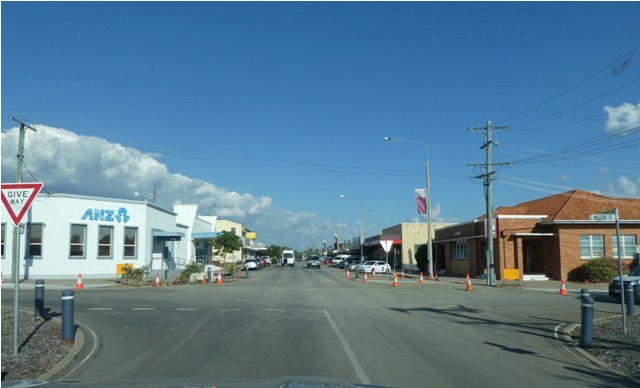
These are a few photos Liz took through the front windscreen as I drove back and forth


through what we though was the most central part of the CBD....at least we found one imposing looking pub!


Some streets of the commercial central were quite open


and even leafy in parts, 


but in the main we found that there was nothing her to overly excite our attention.


We did venture beyond the CBD thanks to a wrong turn and an inability to go back whence we had come. It then became evident that this town is quite spread out, but we both agreed all that we had seen to date was relatively unremarkable.

Mind you, in fairness, this was a very short jaunt, and had we had more time I am sure we would have visited the nearby Callide Dam where all reports laud the fishing prospects, even from the banks of the lake. Barramundi, yellow belly (callop) and other fine freshwater species are all to be found here. There are also abundant redclaw, but after our recent experience these are no longer an attraction.


This really is a lovely spot, as seen here (thanks to 'sweetwaterfishing)', but unfortunately any chance to spend a day or so on the shore in the van has recently been nipped in the bud by the company which controls the dam. 


Apparently the irresponsible action of many of the locals (including leaving fires abandoned whilst still blazing, for example, and other stupidity) has prompted this action, something which has caused a bit of a stir amongst a group of regular grey nomads who normally come here annually. As they commented in a local news article, Biloela is now going to miss out on quite a deal of added commercial impetus when they take their spending elsewhere.  The 'free camping' debate continues to rage!

As I noted earlier, Biloela is the hub of the Banana Shire, where the local economy is supported by the coal mine and extensive grazing and cropping, something we had certainly noticed as we travelled down from Dululu. Wheat, cotton and sorghum are the main crops, and as we saw, hay production is widespread. As an adjunct to local cattle production, Biloela is home to an abattoir of some significance, the third largest in the State in fact. 

Now all that leads to a very interesting question, more of a conundrum really. Included in all the local agriculture there is not a single mention of 'bananas', and with good reason.....this area is entirely unsuited to the production of these fine fruit.

So why on earth is this area blessed with the moniker of the Banana Shire? The answer is quite extraordinary, and another of those 'only in Queensland' yarns.

This shire is named after the first town in the area, the town of 'Banana', so called because it was established near the burial site of a big brown bullock......and, dear contestants, the bullock's name is?  Correct....'Banana'!  So there you have it.....how incredible, and as I said before, only in Queensland!


But for now, it's back to our park where we took the time to follow the invitation on the entrance sign to "view the many displays on site", some of which are housed in the large shed not too far away across this open ground.


This is the home of Callide Dawson Machinery Preservation Club Inc., members of which are the volunteers who manage the park.


By all accounts this is a very active group within the community (as evidenced by the establishment and management of the park in which we were staying), and rallies of enthusiasts are a common occurrence here.


As we wandered under the quite imposing entry arch of the exhibition shed, the ability of this mob of machinery maniacs to cater for a large gathering was immediately obvious. This is a serious camp kitchen.


Equally obvious was the apparently trusting nature of this group.....all the liquor fridges were fully stocked with beer and bottles of wine. Now admittedly they were secured, but this building does not have doors or any other means of locking the contents away. We could only assume that all we nearby campers had a secret secondary role.....human guard dogs, ready to react instantly to any nefarious night time noise of a breaking glass variety.


Apart from the imposing catering facilities, this shed was crammed with all sorts of mechanical odds and sods,


including a few which were clearly of a venerable age (we think this is an old hay baler, but don't quote us).


All this mechanical mayhem continued beyond the confines of the shed


and it was here that we came across something which remains a mystery to us to this day.


I must confess that all these mechanical marvels held little real appeal to us, but 'when in Rome.....' 

So we dutifully completed a circuit of the paddock which brought us back to the rear of the park office building and the most imposing water tower which dominates the local landscape and the collection of caravans in the park. 


The trees near the tower surround a delightful little lake,


next to which stands the park ablution block which is more than fit for purpose


with its row of very clean and functional self contained cubicles. 


All in all, despite our problematic neighbours, we decided that this choice of park had been a good one, and as we relaxed under our awing with a quite evening aperitif we were even treated to what looked very much like an outback sunset.

Needless to say, an early night was in order. Another drive of over 300 kms into Burnett Heads awaited us on the morrow.