Gilgandra, aboriginal for 'long waterhole' ,e major national highways meet, in a way which can be somewhat confusingly for the novice traveller.
From here the Newell Highway runs all the way south to the River Murray at Tocumwal, the Oxley Highway wanders west to Warren, whilst the Castlereagh takes travellers north through New South Wales and across the border to another junction town with which we are very familiar, St George in southern Queensland. Is it any wonder that a constant stream of large transport vehicles of all shapes and sizes and an equally mixed cohort of caravans is an unavoidable sight in Gilgandra.
Of all this we were aware. What we did not know until now was that this town is also known for its windmills, or at least it was, and for the first of the peculiarly Australian WW1 recruitment marches, but more of this shortly.

A turn style gate in the park fence behind our site

took us to the path across the open ground to the Castlereagh road bridge

a crossing which fortunately (for us) included a pedestrian path.

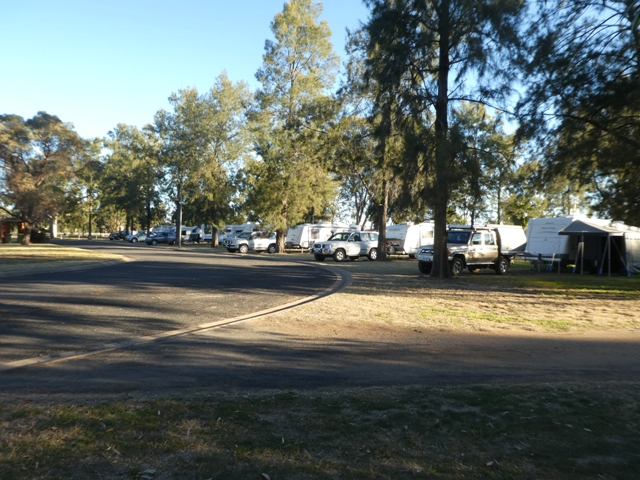
From here we could look back to the curve of the Newell Highway as it sweeps past the park in which we were ensconced for the time being, where, oddly enough and right on cue, we could also see an approaching caravan!

Here at Gilgandra, in common with much of what we had seen of it in other places (notably at Gulargambone some 60 kms to the north), the Castlereagh River is anything but a teeming torrent, but at least on the upstream side of the bridge it did present as a 'long waterhole'.

It was anything but downstream although there were the odd pools here and there.

The bridge across this 'underground' river ends at the first of the highway junctions to be found here (more vans.....

....and trucks)

where a left turn leads to the continuation of the Newell Highway whilst one to the right heads off to the Castlereagh. This town might well be known as the town of windmills, but it is also the 'town of highway signs'.

Beyond this first junction we took the footpath off to the right, in towards the beginning of the town centre area, but before getting there we passed the second of the major highway junctions,

this time that of the Castlereagh and Oxley Highways,

again well signed.

At this junction we came across the large town clock and memorial gardens with the well pruned roses just coming into bud (and yet another highway sign board which, whilst undoubtedly necessary, did nothing to improve the view).

In the opposite direction from this point, the road curves

into what becomes the main street of the Gilgandra CBD. I am now going to revert to a series of photos which I think capture the general essence of what we saw in this town without having to resort to an endless (boring?) series of shots.

Firstly, the red brick buildings of some substance, which included the movie theatre at the head of the main street,

and a little further along, the most imposing Royal Hotel,

opposite which stood the equally impressive edifice which houses the National Australia Bank.

The Masonic Hall, which we later discovered in one of the side streets, was of a similar ilk but far less imposing.

In complete contrast to the solid and slightly austere grandeur of these buildings, the main street was also home to a completely different form of architecture in which wood had been the material of choice. This quaint old fashioned main street garage was one example (don't you just love the 'reduce speed' sign).

This 'old wares' shop with it's side wall mural was another prime example.

Surprisingly to us, art deco is a featured style of many of the Gilgandra buildings within the confines of the CBD. The colourful facade of the Christian Outreach building,

the stark white of the local Target store,

and the more modest but unmistakable style of this cafe and news agent were but three examples.

What we found even more surprising than the adoption of this style widely along the main street, was the fact that the nearby, large IGA store, one street back from the main drag, had been built along the same lines. This building is less than ten years old but is certainly art deco in appearance.

I mentioned at the outset that Gilgandra is know as the 'town of windmills', and here is the explanation. What this plaque does not tell us is the fact that in the days of yore, over 300 of these wind driven pumps were extracting water from the underlying aquifer.
This is all remembered courtesy of the 'Windmill Walk' where, as the tourist blurb notes, "Today you can recall the picturesque past with a stroll down Windmill Walk........a beautiful avenue of trees and windmills that meanding (sic) along the banks of the Castlereagh River....."

Time constraints and other matters of interest precluded us from indulging in a 'meanding', but we did note that the windmill theme was alive and well in the shopping precinct where this logo appeared in all sorts of spots,

in addition to this more solid reminder standing in a small area near the news agent's shop.
The other event which put Gilgandra on the map so to speak, and about which there is a retained sense of community pride notwithstanding the fact that it took place way back in 1915, is the so called 'Cooee March'.
Each October long weekend this march is celebrated in the town. So what happened over 100 years ago which was so significant? Obviously Australia was at war at the time. Troop losses overseas had been significant, and 'recuriting committees' began to spring up in towns throughout the country.
To give more practical effect to the need for new volunteers, on 10 October 1915, a group of about 30 men who had decided to enlist, led by the redoubtable W.T. (Captain Bill) Hitchen, set out to march from Gilgandra to Sydney. In each town through which they passed they would yell out the iconic Australian bush call of 'cooee'. By the time the marchers reached Sydney on 12 November, their numbers had swelled to (the records vary) about 300 men.
This feat, the Cooee March, became known as the 'Gilgandra snowball' and the example set by these men was soon emulated around New South Wales and Queensland. Each subsequent march was individually named (Wallabies, Waratahs, Dungarees, Kangaroos and so on) and although they only resulted in swelling the ranks of the armed forces by about 1,500 recruits in all, these marches attracted wide publicity and enthusiastic support in each of the towns through which they passed.

This plaque, not too distant from the main street and the unmistakable Royal Hotel, commemorates the point at which the men assembled and stepped off.

An impressive statue overlooking the town's main street,

this mural on a wall opposite the Royal Hotel,

and a pair of metal cut out figures in a nook off the main street footpath, are further reminders of these events of late 1915.
But what became of the instigator of this unique recruiting method? Well although Bill shipped off to England preparatory to joining the fight on the Western Front, he didn't actually get to fire a shot in anger. Apart from being diabetic, 'Captain Bill' (so nicknamed because he had been the Captain of the Gilgandra rifle club) was stricken with melanotic sarcoma, a form of malignant cancer which laid him low on 3 September 1916. He lies to this day in the St Mary's churchyard cemetery in Middlesex. What a sad end to such an extraordinary chap.

Before we depart the main street, a couple of snippets which I could not resist......firstly a butcher with a sense of humour!

And then there is the challenge to distinguish the locals

from the tourists....no prizes given!

 Although we did not venture as far afield as the windmill walk, we did take a stroll along the Warren Road (Oxley Highway), where the imposing old building which is now home to the local Toyota dealer rises above a corner at the first junction. Looking at the age and condition of this building
I was relieved to find that the real 'business end' of this dealership was housed in a much more modern facility.

Our stroll took us past the local library and a medical centre,

and the Windmill Motel opposite. This place or respite for the weary traveller

and its nearby neighbour, the Gilgandra Motel, are but two of ten such establishments in this moderately sized town, a testament to the fact that it sits astride three major highways.

The Warren Road is also home to the leafy open space of Gilgandra's Hunter Park,

and a short stroll further on we came to yet another red brick building, this time the Post Office with the community radio station in close company behind it.

On one of the opposite corners, the staff of the Tattersalls Hotel stand ready to slake a thirst or quash the tummy rumbles of the hungry.

Here too, we found another of the town's butchers and the adjoining store and cafe of the Johnson family

with its decorative wall mural depicting the way things were.

Finally, in this neck of the Gilgandra woods, we came across the long, somewhat sprawling building to which employees of the Shire Council report for duty.

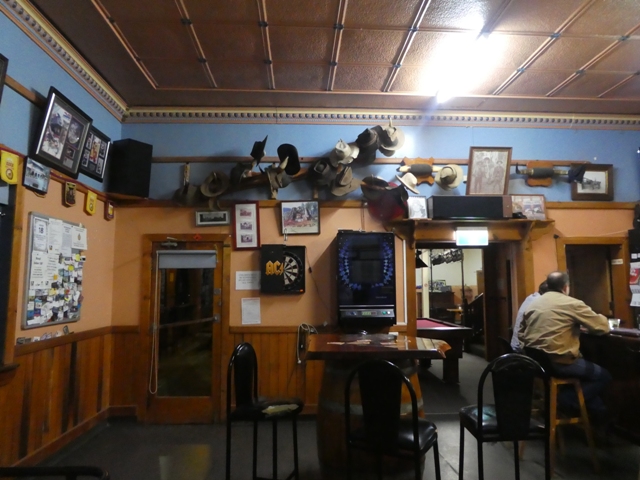
On our return ramble through a couple of the back streets, we discovered the Gilgandra Services Club. We returned to darken the doors of this establishment later that afternoon where we rubbed shoulders with a few of the locals and enjoyed a pleasant evening meal.

Let me conclude our quick tour of this interesting town with a reminder of the fact that the normal appearance of the Castlereagh River with its limited water flow and oft dry beds, can be deceptive. Even this 'underground' river can occasionally bare its teeth as this sign on a post opposite 'The Royal' shows. This is the height of the flood waters which raged through Gilgandra in 1955.

And finally, whilst Gilgandra might be home to windmills and the cooee march, we could not help but notice that it also hosts incredible numbers of pigeons. These 'feathered rats' congregate in extraordinary numbers atop many of the CBD buildings, clustered around air conditioners

and lining gables and wall ledges.

And even if one did not look upwards, the evidence of their presence is all too unpleasantly clear at ground level. What attracts them here in such numbers was beyond us. This is the sort of flocking we would expect around a grain silo, of which there were none to be found. I meant to make some local enquiries, but forgot, so this will just have to remain one of our travelling life's mysteries.
As we re-crossed the Castlereagh and repaired back to camp we both agreed that our decision to tarry here for a couple of days was well made. Tomorrow we head off to yet another 'first', the central NSW town of Condobolin, via Narromine, the home of another 'pigeon' (cricket fans will know what I am talking about), that master of fast bowling, Glen McGrath.
From here the Newell Highway runs all the way south to the River Murray at Tocumwal, the Oxley Highway wanders west to Warren, whilst the Castlereagh takes travellers north through New South Wales and across the border to another junction town with which we are very familiar, St George in southern Queensland. Is it any wonder that a constant stream of large transport vehicles of all shapes and sizes and an equally mixed cohort of caravans is an unavoidable sight in Gilgandra.
Of all this we were aware. What we did not know until now was that this town is also known for its windmills, or at least it was, and for the first of the peculiarly Australian WW1 recruitment marches, but more of this shortly.

A turn style gate in the park fence behind our site

took us to the path across the open ground to the Castlereagh road bridge

a crossing which fortunately (for us) included a pedestrian path.

From here we could look back to the curve of the Newell Highway as it sweeps past the park in which we were ensconced for the time being, where, oddly enough and right on cue, we could also see an approaching caravan!

Here at Gilgandra, in common with much of what we had seen of it in other places (notably at Gulargambone some 60 kms to the north), the Castlereagh River is anything but a teeming torrent, but at least on the upstream side of the bridge it did present as a 'long waterhole'.

It was anything but downstream although there were the odd pools here and there.

The bridge across this 'underground' river ends at the first of the highway junctions to be found here (more vans.....

....and trucks)

where a left turn leads to the continuation of the Newell Highway whilst one to the right heads off to the Castlereagh. This town might well be known as the town of windmills, but it is also the 'town of highway signs'.

Beyond this first junction we took the footpath off to the right, in towards the beginning of the town centre area, but before getting there we passed the second of the major highway junctions,

this time that of the Castlereagh and Oxley Highways,

again well signed.

At this junction we came across the large town clock and memorial gardens with the well pruned roses just coming into bud (and yet another highway sign board which, whilst undoubtedly necessary, did nothing to improve the view).

In the opposite direction from this point, the road curves

into what becomes the main street of the Gilgandra CBD. I am now going to revert to a series of photos which I think capture the general essence of what we saw in this town without having to resort to an endless (boring?) series of shots.

Firstly, the red brick buildings of some substance, which included the movie theatre at the head of the main street,

and a little further along, the most imposing Royal Hotel,

opposite which stood the equally impressive edifice which houses the National Australia Bank.

The Masonic Hall, which we later discovered in one of the side streets, was of a similar ilk but far less imposing.

In complete contrast to the solid and slightly austere grandeur of these buildings, the main street was also home to a completely different form of architecture in which wood had been the material of choice. This quaint old fashioned main street garage was one example (don't you just love the 'reduce speed' sign).

This 'old wares' shop with it's side wall mural was another prime example.

Surprisingly to us, art deco is a featured style of many of the Gilgandra buildings within the confines of the CBD. The colourful facade of the Christian Outreach building,

the stark white of the local Target store,

and the more modest but unmistakable style of this cafe and news agent were but three examples.

What we found even more surprising than the adoption of this style widely along the main street, was the fact that the nearby, large IGA store, one street back from the main drag, had been built along the same lines. This building is less than ten years old but is certainly art deco in appearance.

I mentioned at the outset that Gilgandra is know as the 'town of windmills', and here is the explanation. What this plaque does not tell us is the fact that in the days of yore, over 300 of these wind driven pumps were extracting water from the underlying aquifer.
This is all remembered courtesy of the 'Windmill Walk' where, as the tourist blurb notes, "Today you can recall the picturesque past with a stroll down Windmill Walk........a beautiful avenue of trees and windmills that meanding (sic) along the banks of the Castlereagh River....."

Time constraints and other matters of interest precluded us from indulging in a 'meanding', but we did note that the windmill theme was alive and well in the shopping precinct where this logo appeared in all sorts of spots,

in addition to this more solid reminder standing in a small area near the news agent's shop.
The other event which put Gilgandra on the map so to speak, and about which there is a retained sense of community pride notwithstanding the fact that it took place way back in 1915, is the so called 'Cooee March'.
Each October long weekend this march is celebrated in the town. So what happened over 100 years ago which was so significant? Obviously Australia was at war at the time. Troop losses overseas had been significant, and 'recuriting committees' began to spring up in towns throughout the country.
To give more practical effect to the need for new volunteers, on 10 October 1915, a group of about 30 men who had decided to enlist, led by the redoubtable W.T. (Captain Bill) Hitchen, set out to march from Gilgandra to Sydney. In each town through which they passed they would yell out the iconic Australian bush call of 'cooee'. By the time the marchers reached Sydney on 12 November, their numbers had swelled to (the records vary) about 300 men.
This feat, the Cooee March, became known as the 'Gilgandra snowball' and the example set by these men was soon emulated around New South Wales and Queensland. Each subsequent march was individually named (Wallabies, Waratahs, Dungarees, Kangaroos and so on) and although they only resulted in swelling the ranks of the armed forces by about 1,500 recruits in all, these marches attracted wide publicity and enthusiastic support in each of the towns through which they passed.

This plaque, not too distant from the main street and the unmistakable Royal Hotel, commemorates the point at which the men assembled and stepped off.

An impressive statue overlooking the town's main street,

this mural on a wall opposite the Royal Hotel,

and a pair of metal cut out figures in a nook off the main street footpath, are further reminders of these events of late 1915.
But what became of the instigator of this unique recruiting method? Well although Bill shipped off to England preparatory to joining the fight on the Western Front, he didn't actually get to fire a shot in anger. Apart from being diabetic, 'Captain Bill' (so nicknamed because he had been the Captain of the Gilgandra rifle club) was stricken with melanotic sarcoma, a form of malignant cancer which laid him low on 3 September 1916. He lies to this day in the St Mary's churchyard cemetery in Middlesex. What a sad end to such an extraordinary chap.

Before we depart the main street, a couple of snippets which I could not resist......firstly a butcher with a sense of humour!

And then there is the challenge to distinguish the locals

from the tourists....no prizes given!

 Although we did not venture as far afield as the windmill walk, we did take a stroll along the Warren Road (Oxley Highway), where the imposing old building which is now home to the local Toyota dealer rises above a corner at the first junction. Looking at the age and condition of this building
I was relieved to find that the real 'business end' of this dealership was housed in a much more modern facility.

Our stroll took us past the local library and a medical centre,

and the Windmill Motel opposite. This place or respite for the weary traveller

and its nearby neighbour, the Gilgandra Motel, are but two of ten such establishments in this moderately sized town, a testament to the fact that it sits astride three major highways.

The Warren Road is also home to the leafy open space of Gilgandra's Hunter Park,

and a short stroll further on we came to yet another red brick building, this time the Post Office with the community radio station in close company behind it.

On one of the opposite corners, the staff of the Tattersalls Hotel stand ready to slake a thirst or quash the tummy rumbles of the hungry.

Here too, we found another of the town's butchers and the adjoining store and cafe of the Johnson family

with its decorative wall mural depicting the way things were.

Finally, in this neck of the Gilgandra woods, we came across the long, somewhat sprawling building to which employees of the Shire Council report for duty.

On our return ramble through a couple of the back streets, we discovered the Gilgandra Services Club. We returned to darken the doors of this establishment later that afternoon where we rubbed shoulders with a few of the locals and enjoyed a pleasant evening meal.

Let me conclude our quick tour of this interesting town with a reminder of the fact that the normal appearance of the Castlereagh River with its limited water flow and oft dry beds, can be deceptive. Even this 'underground' river can occasionally bare its teeth as this sign on a post opposite 'The Royal' shows. This is the height of the flood waters which raged through Gilgandra in 1955.

And finally, whilst Gilgandra might be home to windmills and the cooee march, we could not help but notice that it also hosts incredible numbers of pigeons. These 'feathered rats' congregate in extraordinary numbers atop many of the CBD buildings, clustered around air conditioners

and lining gables and wall ledges.

And even if one did not look upwards, the evidence of their presence is all too unpleasantly clear at ground level. What attracts them here in such numbers was beyond us. This is the sort of flocking we would expect around a grain silo, of which there were none to be found. I meant to make some local enquiries, but forgot, so this will just have to remain one of our travelling life's mysteries.
As we re-crossed the Castlereagh and repaired back to camp we both agreed that our decision to tarry here for a couple of days was well made. Tomorrow we head off to yet another 'first', the central NSW town of Condobolin, via Narromine, the home of another 'pigeon' (cricket fans will know what I am talking about), that master of fast bowling, Glen McGrath.