St George, located on the banks of the (sometimes) mighty Balonne River, is uniquely situated at the junction of the Balonne, Barwon, Castlereagh, Carnarvon and Moonie Highways as well as the St George and Mitchell Roads.
One would expect heavy traffic mayhem. Not so. The very functional heavy vehicle by-pass diverts all but a small number of those peace-destroying monsters well around the town. The result is that St George itself is a pretty and relatively quiet township. It is promoted as being one of real natural beauty, due in no small part to the fact that its two main streets are lined with flowering trees, jacarandas and bauhinias.
One would expect heavy traffic mayhem. Not so. The very functional heavy vehicle by-pass diverts all but a small number of those peace-destroying monsters well around the town. The result is that St George itself is a pretty and relatively quiet township. It is promoted as being one of real natural beauty, due in no small part to the fact that its two main streets are lined with flowering trees, jacarandas and bauhinias.

The bauhinias, pictured here stretching for over a kilometre through and out of the centre of SG (it is almost impossible to give a proper perspective with my limited photographic equipment..and skills), produce a brilliant display of purple, pink and white flowers in spring, followed closely by the equally impressive purple offering of the jacarandas. We have marked our travelling book with 'be in St George in spring'.
Aside from the many types of agricultural activity (including grazing, fruit, vegetable, table grapes and melon production) which takes place around SG, the town is the hub of the local southern Qld cotton industry. We had been driving past cotton fields for some days now, so I decided it was high time to learn more about the industry, particularly in light of the somewhat jaundiced view we in South Australia have held as a result of the alleged water use by some cotton growers during the drought years.
Now I would not go as far as to say I have experienced an epiphany, but my views about the cotton industry have definitely altered to the extent I am now much better informed.
Most of Australia's cotton is grown in NSW (70%). The remainder is produced in southern QLD, where both irrigated and dry-land crops are grown. We had seen many dry-land plantations around the Boomi area, but at St George the construction of the EJ Beardmore dam has allowed for irrigated farming.

(the white dots at the far side of the field are cotton bales awaiting transport to the gin)
Some 300,000 hectares are currently under cotton in Australia, which, together with Egypt, produces the world's finest fibre. The annual production of approximately 1.3 million bales (each of about 270 kgms), most of which is exported to south-east Asian countries, particularly China, brings in an export income of over $750 million.
Australian cotton is particularly prized for its colour, the length and strength of its fibre and a lack of contamination.

In all our travels to date, we had never actually seen cotton ready for harvesting. At this time of the year most of the crop has been taken off. But coming into St George we were lucky...one field only!

The 'ripe' cotton fibre, or lint, is contained in the cotton boll, together with a significant quantity of seed.
The huge commercial harvesters take off the seeds, and a deal of plant stalk as well as the lint before compressing it into either rolled or oblong bales which are then transported to the nearest cotton gin for processing. The St George gin was in full swing.

Hundreds of both bale types were stored for processing. I didn't get to the bottom of the reason for the different bale shapes, but we were fortunate enough to actually see one of the oblong variety being off-loaded. One of these bales fills the trailer.

The ginning process separates the cotton lint from the seeds to which it is attached. These themselves are a valued product in their own right and make up approximately 55% of the picked cotton's weight. The pressed seeds produce cottonseed oil, which has an wide range of uses including cooking, stock feed and the manufacture of plastics, cosmetics, margarine and candles.
Even the 'cotton trash', the stalk and leaves, are of value. Believe it or not, one of the uses of this by-product is to clean up oil spills. Much is used in the production of ethanol, whilst the remainder is mulched back into the soil.
Cotton is widely susceptible to insect damage. Indeed, this presented a real impediment to the success of early cotton production in Australia. A significant amount of on-going research is taking place to improve resistance to insect and other forms of attack and to improve quality and yield (Australian cotton production is the highest yielding in the world...by a long shot). Notwithstanding the efforts to eliminate the need for chemical intervention, one needs to but look at the type of aircraft common in the local airports of this region to realise there is still some way to go.

Pawnee tugs and other crop dusting aircraft predominate!
But enough of cotton. What of the township of St George itself? I suspect many will remember the fact that SG, together with many other Queensland towns, featured heavily in our southern news services over the past few years as they were subject to severe flooding, either actual or threatened. The Balonne River, along the banks of which SG has been built, is the first inland waterway we have seen which reminded us starkly of sections of the River Murray where we have spent many happy weeks house-boating.

It is a lovely river. The town weir holds back sufficient water to ensure that this wonderful wide reach stretches upstream for some kilometres. A linear walking path makes a stroll along the bank a simple matter.

The tourist blurb promises those enjoying this riparian splendour the opportunity to spot both birds and koalas. We missed the koalas, but did see many black kites wheeling in the thermals and any number of white necked herons, one of which posed beautifully for us.

The somewhat rustic northern end of the river walk

is in stark contrast to the Apex Park located some kilometre or so to the south. In addition to the usual picnic facilities common in such parks, we discovered a quaint river bank sound shell,

a memorial to those who had served in the various wars,
and, close by, another war service memorial of particular local interest and significance.

The 'St George Pilots Memorial' (sic) is dedicated to Squadron Leader John Jackson DFC (on the left) and Warrant Officer Leonard Walters, both of whom flew in WW2. Jackson, a Kittyhawk fighter pilot, was the O/C of 75 Squadron which was based in New Guinea. Having survived being shot down and swimming ashore during the battle against the Japanese, he was later killed leading his squadron in what amounted really to a suicidal attack against overwhelmingly superior enemy forces. In recognition of his extraordinary efforts to blunt the Japanese advance on Port Moresby, the airport in that city is now named in his honour. He remains the only Australian pilot to have that distinction.
Walters, an aboriginal Australian, who was born on a station near Boomi where we had luxuriated in the hot spa, completed his pilot training after initially enlisting as an aircraft mechanic. He also flew Kittyhawks. He survived the war as its only known Aboriginal fighter pilot. Extraordinarily, Liz and I had previously come across a dedication to Walters in an aircraft museum in Narrandera, some three years previously. What an interesting country it is.

Our walk along the Balonne on St Georges Terrace (remember this name) took us past three of the town's several pubs, in the centre of which we found the offices of Barnaby Joyce, that colourful Queensland senator who has lived in SG for some time. (the cream building centre shot). I make no further comment!
Apart from the relatively large and modern Balonne Shire council chambers, SG is not a town of any discernible architectural note,

but this comment is not one of the slightest criticsm. We found SG to be a very welcoming, comfortable place in which to spend some few days. But, whilst on the subject of local government, a quick tale of an encounter, with Donna Stewart, the local Mayor no less. Liz and I were restocking in the local IGA when I spotted this elegantly dressed lady with the distinctive white streak in her otherwise dark hair, a visual trademark if ever there has been one. Now I know you all know me as a shy and retiring type, so it will undoubtedly come as a huge surprise to read that I could not help but toddle over for a chat.
I was really quite pleased to have the opportunity to tell her how impressively she had presented on our TV news services during the flood crises. She was a little taken aback, as one might expect, but proved to be a most gracious and charming woman who was more than surprised to hear the degree to which SG's challenges had featured in the southern states.

So, back to the floods. The Balonne River, during our stay in SG, was the epitome of benign beauty. But that is not to say it lacks bite. This riverbank marker shows the levels the river has reached during the many occasions on which it has flooded.
Perhaps more perspective of just what this means can be gained from this shot which shows the height of the street above the river level.

I recalled seeing TV footage of the frantic efforts to build a massive levee bank in SG to protect against the rising waters, but could not for the life of me find it anywhere in our wanderings. All was revealed in a later visit to the information centre. It has been removed!
In fact, the levee has been built right along St Georges Terrace and removed after the crisis on a number of occasions. Significantly, whilst these efforts did save the CBD from inundation, nothing could be done to prevent the flooding of many homes further downstream from which over 1,000 folk were evacuated. A great deal of work has recently been done to fully understand the behaviour of the river in flood with a view to the construction of permanent barriers. I wish the good folk of SG every success.
We spent four days in SG, not entirely pre-planned. As I adverted to previously, Liz and I had both come down with nasty respiratory infections. A few days with our feet up was mandatory if we were to cope with the fairly challenging northward travel confronting us in the following week or so.
Let me say, if one has to prop somewhere, we couldn't have chosen a more pleasant spot. The Pelican Rest Caravan Park provided us with large, well grassed sites, immaculate new amenities and a helpful and welcoming staff.

Our site was at the end of this row of drive-throughs, which, at mid morning looks somewhat deserted, as indeed it was on our arrival.

How can such a lovely park be so quiet, we wondered? It isn't. Rarely have we sat in a park which experiences such a flood of daily arrivals and departures. By late afternoon every vacant site in this row, and many of the myriad of others available, was occupied, and, like the ebb and flow of the tide, all was again vacant by the following mid-morning. According to mine host, Steve, this is all down to the SG's location at the junction of so many major highways. Of course the fact that all us southerners are streaming north to chase the sun at this time of the year does contribute.
We really did make the most of the delightful, sunny days to good effect as far as our

health was concerned. Whilst we left SG still a little peaky, we were both much improved.

That is not to say we totally hibernated, as the previous photos demonstrate. In addition to our river bank and other town meanderings, we did manage to fit in a quiet afternoon drink at the very large local RSL (as is my want).

And whilst on the subject of returned soldiers, I must include a snippet or two courtesy of our park neighbour who pulled in a day after our arrival. His van displayed the ribbon bar consistent with service in Vietnam, but then, to my astonishment, he hoisted a serious flagpole on his A frame from which he flew the Australian flag and below it, a flag of the Vietnam service medals. I'm disappointed there was insufficient wind to capture this display in its full glory, and whilst applauding his dedication to his service, 'overkill' did cross our minds.

Mind you, if the additions to the exterior of his van are anything to go by, I suspect this good veteran was also a real character. In fact I was a little annoyed circumstances (mainly my state of illness driven withdrawal) prevailed against our meeting for a yarn.
Everyone who has parked a van on a site will relate to this!

But the real gem was to be found on a side locker. Yes, they are fake 'blowies'. Would it surprise you to learn that this locker houses the toilet cassette? As I have often said, "only in Australia".
And before we leave the SG 'quirky file', we must share with you the thought that if we ever lived in this town we would definitely join the tennis club. This was the supply run for the forthcoming weekend tournament, reproduced here with the full permission of the driver of

this ute who was clearly looking forward to the festivities with some enthusiasm. I never did discovered if he actually plays tennis. Either way, he is an obvious stalwart of the club.
And I nearly forgot. SG houses the most incredible collection of carved emu eggs to be found, (accordingly to the attendant publicity in the shop....of which there was plenty!) in the world. The relevant brochure proclaims that 'The Unique Egg...has to be seen to be believed.' Indeed it does. The Greek born carver, Steve Margaritis, has accumulated a display over the past forty years. The hollowed eggs are fashioned with the most astonishing range of patterns and themes. All are mounted over small internal lights which shine through the eggs which are displayed in a darkened room, many in front of three sided mirrors. The overall effect is breath-taking, an effect which is highlighted by the fact that access to the display is gained by walking through the sporting and gun shop to which the room is attached. Again, where else but Oz?
Despite the reason for our somewhat prolonged stay in St George and the fact that there were many things still to be discovered in the area, primarily the very good fishing which abounds in the rivers and dams, we thoroughly enjoyed our stay. We had farewelled the Vogts the previous morning and were now ourselves again on the road northwards, to our next destination, Injune. "Where", you ask? Injune, a tiny town 90 kms north of Roma on the Canarvon Highway (ah, now you know where we are!) And of course, the next obvious question, "why Injune?", the answer to which lies in the fact that we had previously spent two days in Roma, and we wanted to cover at least 300 kms on each day of our travel towards Atherton.
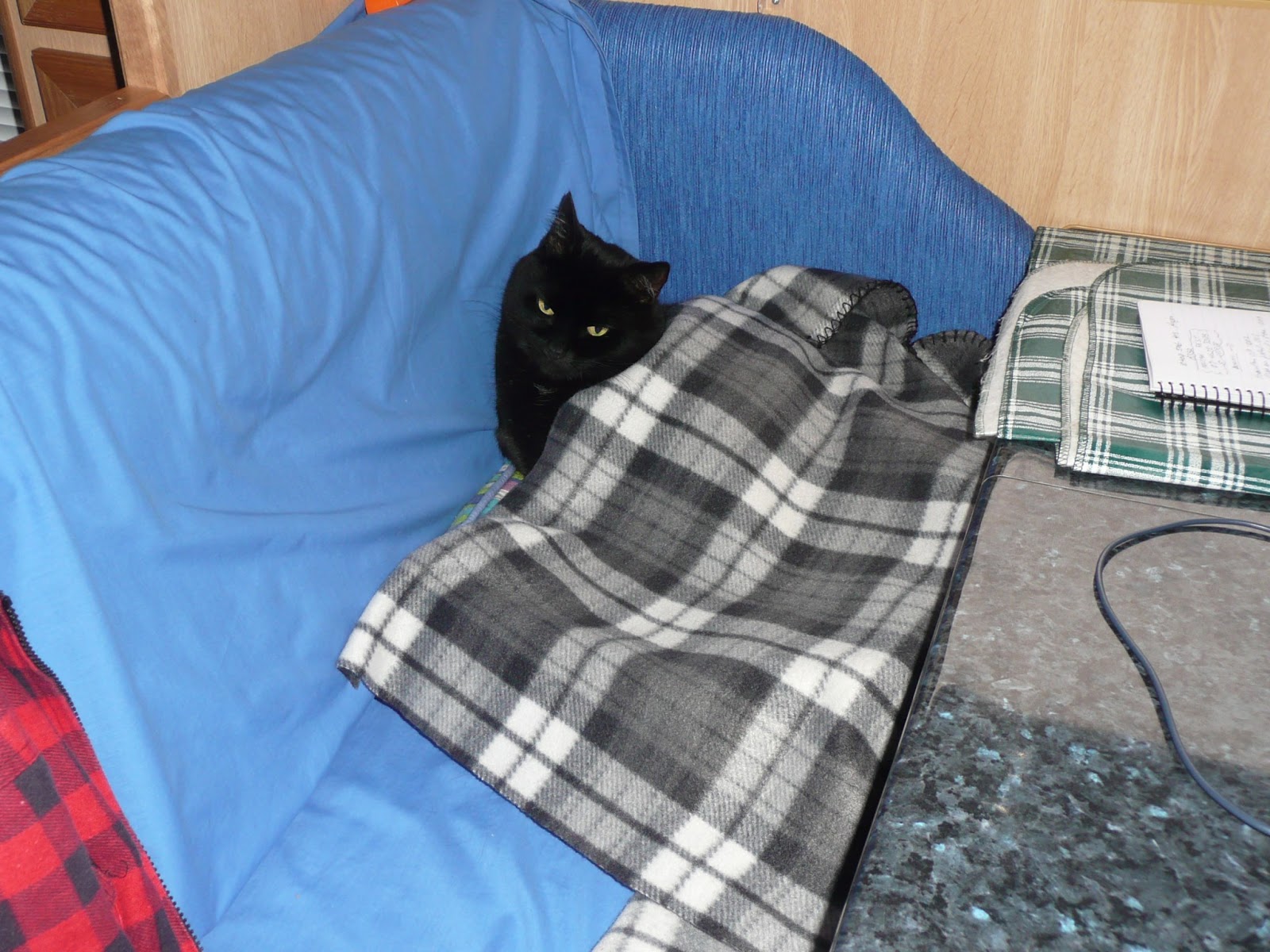
And, as so often happens, we were in for a treat. But more of that in the next blog, which may not now be for some days. Believe it or not, with pictorial editing, text production and photo loading (which is a real drag in terms of elapsed time per shot) and final editing, this offering, for example will have occupied me for just over six hours. When we are travelling hard, consistent work at the computer can present a challenge. And for those who may be interested in some perspective, here is the site of all this documentary enthusiasm, being well guarded in my absence by the Black Panther.