Thursday, 28 May 2015

ONLSOW - POINT SAMSON (6 MAY 2015)

We were on the road again.  Destination.....Port Sampson, about 50 kms east of Karratha. We had decided to use this as a staging point from which to visit Karratha itself, Dampier, Roebourne, Wickham and the old town of Cossack as well as the ore loading facility at Cape Lambert. We were in for a busy time, but first we had to get there.

I could not resist one last photo of the Onslow Memorial, not least because on this, our day of departure, I was actually up before the sun rose!


Was I happy with the result....you bet I was!  As I walked back to the park I could not help but think of this venue for the Anzac Day dawn service....it would be sensational.


I had hitched the day before, and we were almost ready to go. Chairs in and legs up, Max taken for his final pre-departure walk and it was into his cage and we were off.


Max can be a devil on these days. He knows when he is in for a spell on the road and he does all he can to avoid the outcome. Once the TV goes under the pillow he is off, looking for a place to hide. We have found that he is much more settled if he has a good gallop around the park before we leave.  It's amazing.....even in parks where he has not been entirely comfortable too far away from 'his patch', on departure day he will try to walk for miles!  


But we're on to you Max....there is no escaping the inevitable. I know....butter wouldn't melt in his mouth. Don't believe a word of it.  He has a very effective way of making his presence felt when he has had enough, despite the recent addition to his cage comfort of a large piece of foam padding. Ingrate!


Once again we marvelled at the numbers of the termite mounds in the Cane River Conservation Park as we rolled south-east out of Onslow in the early morning light


and made our way to the junction of the North-West Coastal Highway.


This was to be a moderately long day (for us).....about 350 kms all told, but it was one full of interest.  Throughout the trip we were left in no doubt that we were travelling through mining country.  This was the first of several overburden heaps and buildings we passed which indicated a mining operation.


The ore carrying trucks of the 'Mesa A' mine soon came into view.  This mine, otherwise known as 'Waramboo', is one of many operated by Rio Tinto in this area. 


Although this operation is not one of the real monster mines, it has one feature which provides some clue to the costs associated with developing these mines. This was a phenomenon we had first come across many moons ago whilst travelling on the Stuart Highway....a bridge which looms out of nowhere for no obvious reason.


It is not until one reaches the top that the its purpose becomes evident. These are purpose built to allow the ore trucks direct passage to and fro beneath the highway.


And sure enough, here were two of them hard at it. Just imagine the chaos if this were a level crossing.


A short time later this roadside sign loomed through the windscreen. We had never previously


taken a great deal of notice of these....there had been no problems with the roads, and I have to confess to a previous attitude of "Why do they put these up...this is a major highway for goodness sake". Our Nanutarra experience had changed that foolishly blase view of this part of the world for good. Irrespective of the forecasts, which I do watch carefully, we now peer most attentively at these advisory notices. Even more, if a flood watch is promulgated in any area within a bull's roar of our destination, we also check the very informative Main Roads website before departure. Once bitten and all that!


From this point on the landscape changed quite dramatically. We now found ourselves traversing flat open country 


as we made our way further north-east towards our planned fuel stop...the Fortescue River Roadhouse.


As we rubbed shoulders on the huge apron with a few of the big boys, typical Pilbara red hills in the background,


I took the opportunity to check out the caravan park at the rear of the roadhouse. This had been another of my planned escape destinations during the approach of TC Quong.  We remain eternally grateful this did not eventuate. Apart from the fact that the roadhouse complex includes a large miners' camp (with all the attendant joys this can bring), the park amenities were filthy and graffiti ridden and the caravan sites were but average.  


Whilst the interior of the roadhouse itself was of a good standard, the same cannot be said for the fellow behind the jump.....he was slow, grumpy and less than user friendly. Hopefully this place employs other staff. In any event, our score for the Fortescue River Roadhouse was 2 out of 10!


We moved on, over the flowing waters of the picturesque Fortescue River


and into another section of the Pilbara flat lands with hills in the distance. This had been a common place view for much of this trip.
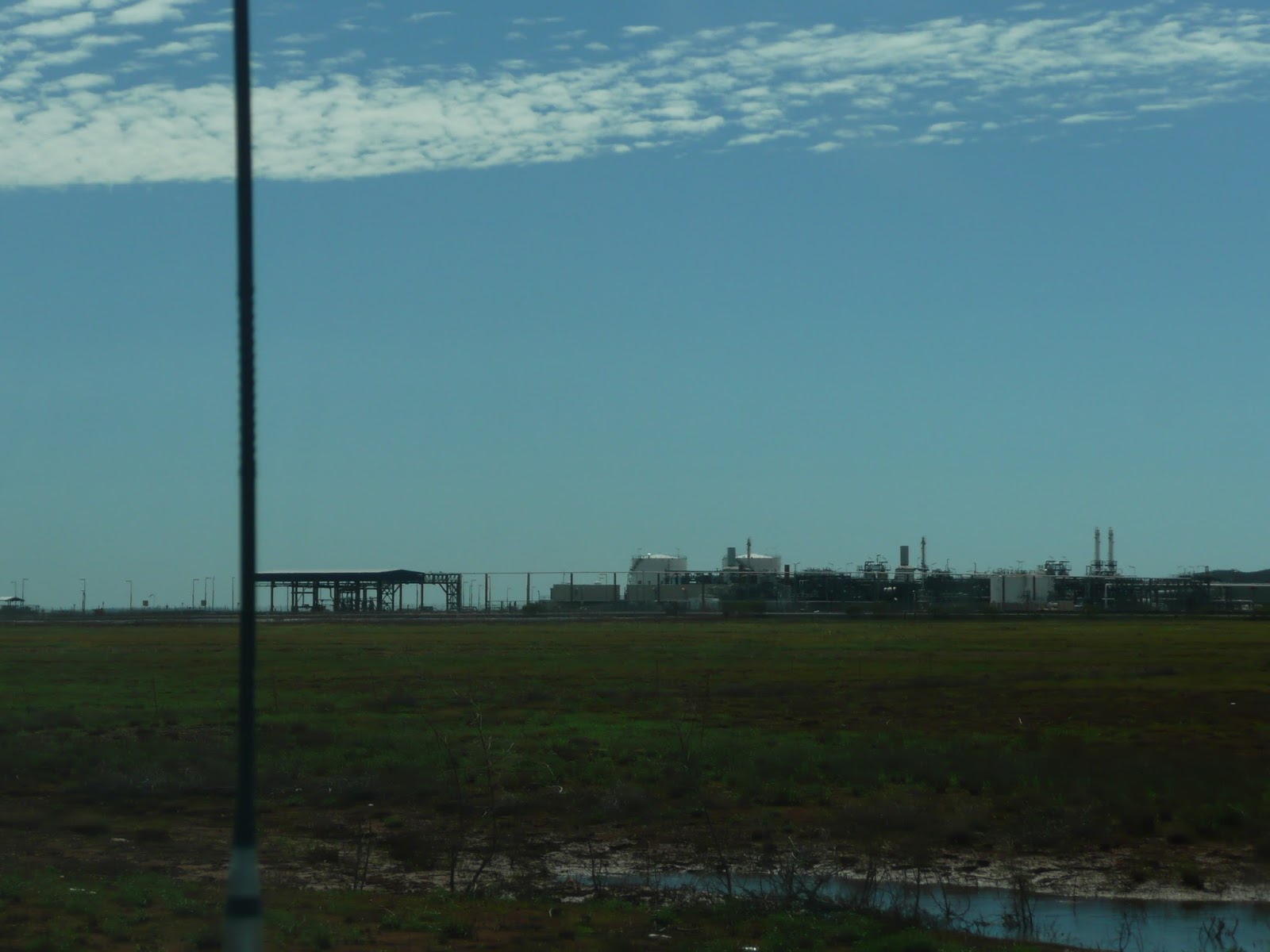


At many points along the way evidence of heavy industrial activity came into view. The Devil Creek gas plant is but one. This plant processes gas brought ashore through 105 kms of pipeline from the Apache operated offshore Reindeer gas platform off Dampier, part of the North-West Shelf gas extraction operation. A smallish, but significant player.


'Gas' and 'iron'....two words synonymous with the Pilbara.  No sooner had we passed the Devil Creek gas plant than we were watching the slow progress of one of this region's huge iron ore trains. These have to be seen to be believed in terms of their length. The 20 ore waggons in picture (come on, admit you checked!) were part of a train of at least 200 of them. 


Again, we were later to see these at much closer quarters, an experience which did nothing to temper our awe (think about it!) in respect of the sheer magnitude of these ventures.


We were getting nearer. A visit to Dampier and the Burrup Peninsula were on our agenda, 


but for now it was on to Roebourne and the turn off to Point Sampson. There is a real concentration of towns and places of interest in this area. This sign listed four of them.


With less than 20 kms now to go we headed out across the flat country which lies between Roebourne and Cape Lambert


past the mining township of Wickham


and the salt pans near the turn off to the old town of Cossack.


The sea was churning in through the culvert as we crossed the tidal inlet near the town


and within a few short minutes we had arrived at the outskirts of Point Sampson which was to be our home for the next week.


As we pulled in were hoping that we had allocated enough time to do all we had planned without running ourselves ragged. Only time would tell, as I shall, in the next few episodes.

Tuesday, 26 May 2015

THE ONSLOW WATERFRONT AND A STUNNING MEMORIAL (3 - 5 MAY 2015)

Our caravan park was called 'Ocena Vew' and our site was designated 'beachfront'.  The 'view' bit was correct, but to call what lay below us at the water's edge a beach was, for us, something which demanded the use of some imagination.  I know we were spoilt living in Adelaide, particularly at South Brighton, where we just took the expanses of white, soft sand for granted, 

but here, anything which is not rock is termed a beach (I must say at this point that this is an observation not a criticism). At high tides the whole issue was irrelevant....the water lapped the rock wall. Here again you can see the results of Cyclone Quong and the outpouring of the Ashburton River in the turbid condition of the usually blue sea. This was somewhat disappointing, but we did see it clear just before we left, and for us, any view over water is better than the alternative.


We were travelling into the 'high tides' part of the WA coast.  When the water fell, as it did late in the afternoon, our 'beach' was exposed as a small strip of course, dark sand and a large rocky shelf which extended a considerable distance. This particular strip is known locally as Sunrise Beach. 


A quick drive around the headland finds one at Sunset Beach, and here, beyond the small park (and the views of the loading salt carrier)


a short walk through the trees


brings the visitor to the much more expansive sands, seen here looking to the north.


In the opposite direction the beach itself is overshadowed by the bulk of the salt conveyor belt, but the sandy strip does extend well beyond that to the south. I was reliably informed that the fishing along here was well worth a try.....if only! The very thought of exposing the wound on my foot at this stage to an invasion of sand or any form of moisture had The Matron huffing and puffing in fits of professional indignation. Beach fishing was well and truly off my present agenda!

But I could walk......sort of.  I invite any of you to try walking without bending your big toe....that was my challenge for a three week period.  I was determined to hobble along somehow, and we did just that on the beachfront path in front of our park. 


To the east this extended past and beyond our caravan park and joined the grassed area of the 'esplanade' which featured a couple of blogs ago.


Westwards, this rather rough, but well used pathway ran past the local fish cleaning station


to the extraordinary Onslow Memorial Park no more than 300 metres from our site.


One of the primary reasons for our visit to Onslow had been to see this park (the fact that we found so much more of interest was a delightful bonus), and believe me, we were not disappointed.


Let me take up the story of this marvellous memorial by quoting directly from the Onslow War memorial website and the press release from the Shire CEO relating to its pending dedication.

"The tiny NW coastal town of Onslow WA (population 750) is abuzz with excitement and anticipation as the dedication service for their recently completed War Memorial draws near.At 11am on Monday 15 September [2014], invited guests, residents and seasonal visitors will gather together at Beadon Point for a simple ceremony to mark what has been an incredible achievement for this small community.

The memorial sculpture, the work of internationally acclaimed artisans Charlie and Joan Smith (HMAS Sydney Memorial Geraldton WA) is a stylized interpretation of the Australia Defence Forces’ Rising Sun cap badge. The sculpture is geographically positioned so that the rays of the rising sun shine directly through the arch each Anzac Day.In the words of one well travelled Vietnam veteran the Onslow memorial is the most evocative tribute he has seen; elegant and eloquent in its simplicity and spectacular location. A truly Aussie salute worthy of the sacrifices that inspired the construction of the memorial............."

Charlie and Joan Smith, no less (you may recall the absolute passion with which I sang the praises of the HMAS Sydney memorial in Geraldton)....no wonder the result is so striking.

So how did all this come about? Onslow, like just about every country town in Australia, had previously housed a memorial to honour those who served in WW1, but with the removal of the town from its original site in 1924, this had been lost. After this the impetus for a replacement had waned over the years with the diminishing number or members of the Onslow RSL.  A few years ago, at a time when a redevelopment of the Onslow foreshore was high on the local agenda, the Shire received a grant from the State Government to be used to commemorate the 65th anniversary of the bombing of the town (such as that was!) 

In their infinite wisdom, the good burghers of Onslow decided that a new Memorial park was the ticket. With the grant funds augmented by contributions from Onslow Salt, the Pilbara Development Commission and a bit more tipped in by the Shire, the Smiths were commissioned, and the end result is now here for all to see.


What a story, and what a triumph for this tiny Pilbara coastal town. In addition to the main memorial, there are a number of other delightful touches, including this bench on which two bronze slouch hats rest (courtesy of Chevron)


and this, installed in memory of seven local fishermen lost at sea when their vessels the 'Lady Pamela' and 'Harmony' foundered in the huge seas whipped up in February 1995 by Cyclone Bobby.


And then, for me, a real little oddity, a stone and plaque commemorating the 50th anniversary of the first British nuclear bomb test on the not too distant Montebello Islands. Given the iniquitous way in which the Brits behaved after the Maralinga tests, and their inexcusably intransigent refusal to provide well deserved compensation to the many who suffered dreadfully as a result of exposure to the resultant radiation, I found this addition to the Onslow Memorial park somewhat distasteful.


On a brighter note, looking back on the park from the beginning of the 'Ian Blair' walkway, you can see the rotunda and sheltered seating installed for any who wish to picnic here or just sit and contemplate life (and death) generally. This entire place really is a triumph of local initiative and drive.


Another surprise....the walkway, which extends 1.1 kilometres from the Memorial park to the small park at Sunset Beach.  Liz galloped its entire length on one occasion whilst I remained 'confiend to barracks'.  But here was the second occasion in this State where we had come across a significant small town acknowledgement of the services of their local member of the constabulary. Ian Blair had been sent to Onslow to police the district in 1959.  After his retirement he chose to make Onslow his home, where he continued to make valued contributions to the improvement of the local lifestyle. "Well done that man"....your name lives on in Onslow!


I did manage one small jaunt along this very well constructed path


to a lookout not to distant along it.


From here we could look down over the coastal scrub to the seafront as it rounded the headland, and it had been from here that we had spent an entertaining hour watching the salt bulk carrier make its way to its mooring at the end of the conveyor jetty.


We also took advantage of this lookout to take in an Onslow sunset on one occasion. It was well worth it.


As we slowly wandered back to our digs in the pastel haze of the distant rising moon, a couple to whom we had been chatting kindly offered to record the moment for posterity.


We did make the most of our our position right on the seafront. What a delight it was to take our ease no more than five metres from our site and raise a glass to the splendour of the sunset,


with the marvellous Onslow memorial silhouetted against the dying colours in the western sky.


And, after many, many attempts, I did manage to catch the lights of some of the vast number of lateral channel markers, which guide ships into the Onslow dock at night, as they flashed (very quickly, once every three seconds). Thank goodness for the digital age...had I been using film this result would have chewed through many metres of it.


We so enjoyed our stay here. Onslow had lived up to all we had expected of it and more. As I said in my introduction, we can understand why this small coastal town would not appeal to many, but for us it was just the shot.  Large, somewhat controversial industrial development on a huge scale, a town of interesting architectural contrasts, one of the best Memorial parks in the country, the sea on all sides, an obviously 'can-do' local community and a caravan park where, on the right site, relaxation is almost mandatory. A return visit is very much on our forward planning books.

Monday, 25 May 2015

INDUSTRIAL ONSLOW (3 - 5 MAY 2015)

Salt and gas, on a large scale.  The 'big end of town' has settled in Onslow for the long haul. We knew about the gas, but the salt came as a surprise. 


As we drove in over the causeway on the outskirts of the town, I guessed that these had to be salt evaporation pans, but it was not until we had settled in and begun to nose about that we became aware of just how expansive the Onslow Salt mining operation really is.


A few salient facts to begin with.  The salt mining (the use of the word mining has always fascinated me......I would hardly call scraping residual salt crystals off a flat evaporation pan 'mining', but the term is used universally....who am I to argue?) operation here in Onslow began with the completion in 1999 of the pans and associated infrastructure, including the construction of the long jetty near the township. Eighty million dollars later, and things were underway. 

The salt pans extend over a staggering 8,600 hectares. We had driven across but one of many. 


An annual harvest of an equally staggering 2.5 million tonnes is loaded onto trucks 


and carted cross country


to the off loading point.


From here the salt is moved by conveyor to the stockpile, a prominent feature of the Onslow landscape,


before it is again shifted by conveyor belt out along the lengthy 'salt' jetty to be loaded into the holds of the bulk carriers which regularly moor here.


We had actually watched this one come in the day before from the walkway just to the west of our park.


The two fussy little attendant tugs soon had the large bulk of the ship firmly alongside. And these are not small vessels.....many carriers which transport the Onslow salt (to China mostly) weigh in at 50,000 tonnes.  


Onslow salt is but one of several large scale producers in this part of the world. We had previously seen the mine at Useless Loop near Denham, had driven past the Rio Tinto operations near Quobba and we were soon to visit the gigantic salt mine near Karratha. Which leads to the obvious question. What on earth is all this salt used for?...surely not just at the table.

Let me quote directly from the Onslow Salt website.

"The world of salt extends far beyond the saltshaker on your table or salt’s traditional use as a preservative in food processing. In Japan, for instance, table salt and salt for food manufacturing and so forth account for only around 20% of salt use, with the remaining around 80% being used as a raw material for production of caustic soda, chlorine and soda ash in the chlor-alkali industry.

The diverse end uses of caustic soda, chlorine and soda ash indicate just how prevalent and essential salt is in our lives. Caustic soda is used in the manufacture of pulp and paper, textiles, soaps and detergents; chlorine’s applications include the extremely versatile polyurethane plastics used in automobile components, PVC (polyvinyl chloride) employed as a building material, water purification and as a disinfectant; and soda ash is used most commonly in the production of glass.

Since salt is a raw material for many commodities, demand for it is closely tied to economic growth and performance. In China, rapid economic development and the emergence of Chinese chlor-alkali manufacturers has led to soaring demand for industrial-use salt, to the extent that in 2004 China shifted from being a net exporter to a net importer of salt. As a result of such rising demand for salt in China, supply has become tight in Asia."

So there you go. Humble sodium chloride is very big business indeed.

As is gas, in this case natural gas, being extracted from below the sea bed off the north-west coast of WA in almost unbelievable volumes.  Here, Onslow, or more particularly, Chevron and BHP Billiton, could learn a lesson or two from their counterparts at Karratha where a particularly informative and well set up Visitor Centre provides wonderful detail about the North-West Shelf gas project from a site directly overlooking the huge Karratha gas plant where Liquefied Natural Gas (LNG), Liquefied Petroleum Gas (LPG), condensate and domestic gas are all produced.  I'll have much more to say about this in a later blog.

Admittedly the gas plants near Onslow are still being developed, but the areas are closed, including the Chevron FIFO village some distance from the town. All I could manage by way of photography was this somewhat distant shot of their Ashburton North plant,


taken from near the mouth of the Ashburton River.  So, in lieu of a pictorial exposition of the goings on here, again let me provide detail from a website, this time that of Chevron Australia.


Their 'Wheatstone Project' involves piping gas from the offshore well platforms to the processing plant near Onslow.


"The Wheatstone Project is nearly 60 percent complete. At the LNG plant site, equipment and modules continue to be delivered and installed. The roofs of LNG Tank 1 and Tank 2 are now raised and construction of the two condensate storage tanks is underway.

At the Materials Offloading Facility, the breakwater is nearing completion and the 1.2 kilometre (0.75 mile) product loading jetty continues to progress.

The offshore gas processing platform is now in place - 225 kilometres from Ashburton North. The subsea equipment, including wellheads and subsea trees, is being delivered and installed offshore.

The platform topsides represent the largest single integrated topsides float-over installation Chevron globally, has ever completed and is the largest offshore platform ever installed in Australia. The topsides weigh 37,000 tonnes, are 28m above sea level and have been designed to withstand 12 storey-high waves. 

The Wheatstone Project will include an onshore facility located at Ashburton North Strategic Industrial Area (ANSIA), 12 kilometres west of Onslow in Western Australia’s Pilbara region. The foundation project includes two LNG trains with a combined capacity of 8.9 million tonnes per annum (MTPA) and a domestic gas plant."

Just look at those numbers....this is a massive undertaking. Chevron does not have it all to themselves.  As I have previously mentioned, BHP Billiton are also in the game. Let me quote from their website of 2010.

"The Macedon Gas Development, to be operated by BHP Billiton, will commercialise natural gas from offshore production lease WA-42-L, located 100 kilometres west of Onslow. First production is expected during calendar year 2013. 

Recoverable reserves for the Macedon field are between 400 and 750 billion cubic feet of gas. Project costs will be approximately US$1.5 billion, of which BHP Billiton’s share will be 71.43 percent (approximately US$1,050 million). The balance will be invested by joint venture partner Apache Northwest with a 28.57 percent interest.

The Macedon project involves four offshore production wells supplying a wet gas pipeline to an onshore gas treatment plant to be constructed at Ashburton North, 17 kilometres south west of Onslow. 

A sales gas pipeline will be connected to the Dampier to Bunbury Natural Gas Pipeline for sale to the domestic gas market in Western Australia. The gas plant will have a design capacity of 200 million standard cubic feet per day."

Yet again, I invite you to look at the numbers.....both development costs and production figures....truly stunning.

Chevron in particular has mounted a significant local public relations campaign designed, from what I could discover, to both inform and placate local opinion with decidedly mixed results.

One of the most controversial aspects of their operations has been that relating to the housing of their workforce. You may recall recent news items on this very matter. A real schism has emerged between Chevron and the Shire authority, in my view with some good reason.


In a nut shell, the Shire wants the Chevron workers to be housed in town. Chevron has a very different view, and the Shire is not happy.  On the basis of initial arrangements, the Shire went ahead with the development of a pretty substantial housing estate on the approach to the town centre.


As you can see, that's as far as it had gone. Chevron's position has always been that it wants to use, in the main, a FIFO workforce, housed in a purpose built estate close to the gas plant. The WA Government has recently backed this stance in a move which has not been well received locally. The argument that the 35 km road trip to work and back from Onslow carries inherent dangers, and would unreasonably add to the length of each shift, has always struck me as pretty thin.

The Shire has, from what I can gather, always argued that a FIFO workforce, dislocated from the local community, does little to support local business and community growth. This is indisputably true. 

I listened with great interest some months ago to the Shire President expressing a significant degree of angst about the stance taken by Chevron and the Government back flip on this matter, and noted at the time that there is increasing, demonstrable and justified concern about the adverse effects a FIFO work environment has on both the workers and their families.

As is usually the case, a compromise of sorts has been reached.  Chevron have agreed to locate a number of its workforce and their families on the new estate whilst also maintaining a FIFO component.  From a local perspective, the sooner this land is built on the better....even during our short stay we saw sand blowing off the bare earth in significant quantities. Mind you, the rain from the recent cyclones showed up a problem with the drainage systems on the estate....this has some distance to run yet.

It would be quite wrong to say that Chevron is running roughshod over the local authorities and putting nothing back into the community.  In conjunction with the Shire, the State Government and BHP Billiton, Chevron is contributing millions of dollars to develop and improve the local infrastructure.


A new airport is currently under construction.


This remains a work in progress, and it could well be argued that there is a degree of self interest in establishing a larger, more functional terminal, but this has to be good for Onslow. It is an interesting looking building.


As I noted in my previous Onslow missive, a new and much need town swimming pool is on the agenda, as is a hospital redevelopment, and improvements to water, power and road infrastructure. Chevron has implmented a very slick PR programme, including the distribution of regular, very glossy updates on their progress. I enjoyed reading these critically.....they are very cleverly done (and yes, you can read into that comment what you choose!)  

And, despite all the hype, there remains a rump of locals who want nothing to do with all this development. They like Onslow as it was.  Sound familiar? 

My thoughts.....the net result for Onslow has to be positive. In fact we have already decided on a return visit in a couple of years to have a good look at the difference (apart from the fact we already like it as it is....there is a deal of 'Normanton' about present day Onslow)


Enough of the big end of town and the local contretemps. We had to take a quick peek at the local small boat harbour in Beadon Creek, the road to which runs off Second Avenue 


and takes one past one of the town's light industrial areas.


Beadon Creek is not the Murray, by any means,


but it provides a good launching ramp for the local boaties,


and mooring for a small fleet of marine 'workhorses'.


This large dockside crane,


floating platform (purpose unknown), and a number of nearby large industrial sheds, demonstrate that this small harbour is very much a working port.


I think that is about enough of 'Industrial Onslow' where, as we discovered, there is a great deal going on, huge investments being made, and much more to come.