Wednesday, 17 October 2012

SYDNEY - GERRINGONG (7 - 14 OCTOBER)

Our site in the Dural caravan park was the tightest we had yet to experience on our trip.  We have discovered that many caravan parks which were built years ago were designed to accommodate much smaller vans than is now the norm with the consequence that rigs of our size can present a problem, even when we are assigned "our biggest site".  In fact, when booking, we now make very sure that we let folk know that we are 29 feet overall.  And therein lies another interesting little quirk of this business....the vast majority of caravan and park owners still talk in feet rather than metres.  But we also know we are 8.8 metres just in case.  
 
The Dural park was a classic example of the problem presented by old park design.  Fortunately our neighbour, who had been there for four months, had become quite used to having to shift her car to allow egress to those next to her.  Even so, just as with getting onto the site, things were a little tricky, but we were soon on our way.  Mind you, I did feel a little under pressure.   This same lass had commented to Liz the previous afternoon that she couldn't believe we got onto the site in one movement...nothing like a precedent!
 
Like most cities, Sydney's Sunday traffic is a vastly more manageable proposition than during the week.  This, combined with the use of the M2, M5 and M7 respectively, made our journey to Picton one of comparative ease. 


As I have mentioned before, even the injustice (in our view) of having to pay a 'heavy vehicle'  toll fades into insignificance when balanced against the benefits of motorway travel around the outskirts of a metropolis like Sydney.  The concept of having to tow through the centre of town is the stuff of travelling nightmares.
 
Picton is a delight.  Whist we did not have the opportunity to take any photos, I could best describe it as a small hills town very similar in many respects to places like Stirling and Aldgate in the Adelaide Hills.  Historic buildings stand side by side with modern amenities.  The provision of goods and services is surprisingly broad.  I was surprised, I must admit, to find a largish building on which equally large advertising invited patrons to have their skin decorated with tattoos and other oddments.  This seemed more than a little incongruous in a town like Picton. 
 
All become clear later when I discovered that the historic King George 4th pub, directly opposite, is the regular weekend watering hole of many of Sydney's biker community.  Indeed, on this particular Sunday, the (very good) group playing on the pub's front porch had attracted a considerable patronage of a clearly biker persuasion, the bared arms of many testament to the skill of those working opposite.  Despite the antecedents of many who frequent this pub on the weekend, trouble is apparently infrequent.  When a pub has Coopers stout on tap and caters to the inner man with Villis pies, peace is assured!
 
Sue and Pete Tansell's 'house on the hill' in a vineyard estate just out of Picton is picturesque to say the least.  What a lovely place to overnight particularly when the driveway is of sufficient size to accommodate the van without the need to unhitch.
 
 
And don't be fooled as to the size of the Tansell mansion from this view.  Looking up from the back lawn provides a much more realistic perspective.
 
 
The outlook from the balcony is equally impressive.  Hills living at its best, and


despite the distance from Sydney, the freeway and motorway systems mean that a drive to the city centre can be achieved in an hour, and in much greater comfort that those who commute over the same time from many outer city suburbs.


We did enjoy catching up with the Tansells who just happened to be babysitting two grandchildren whilst one of their daughters and her husband made a day of it at the Bathurst motor races.  Our pre-departure breakfast on the balcony was a real family affair.


From Picton we made our way down Picton Road, over the escarpment of the Great Dividing range to join the Pacific Highway near Woolongong.  We had reached the Illawarra district, which, apart from Woolongong includes the major towns of Kiama and Nowra.  Gerringong, our destination for the next week, is a town of some 3,500 souls which lies some 10 kms south of Kiama.  Like most in this area, it is 'billygoat' country.  In fact, a level driveway in Gerringong is a real find.  But, of course, the upside of this is the fact that many of Gerringong's houses command wonderful views over the spectacular Werri Beach and its headlands, or, to the west, the green and rugged face of the nearby ranges.  But more of that later.
 

Our main purpose in visiting Gerringong was, of course, to spend some time with number two son Stu, who, for those not entirely familiar with my family, is a navy Seahawk helicopter pilot, currently based at HMAS Albatross in nearby Nowra.  Stu lives in Gerringong, quite close to the Werri Beach caravan park which we made our home for the week. 


We had also arranged to catch up with our old and dear friends the Banninks during this week.  To our delight we were unexpectedly joined by Chris and Dick Hodder.  Dick is another of the group of Qantas pilots which whom I have been friends since 1974.  Party time!  Our single van soon became a real campsite.


Another wonderful surprise was in store.  As Stu pulled into the park to join us for tea shortly after our arrival, we saw that his charming girlfriend of some years, Briony, was with him.  How unlike Stu to have failed to let us know beforehand that she was staying with him and that there would be one more at the table!  As we all later agreed, Stu may be a brilliant pilot, but he really does need a social secretary.  I wonder where he gets that from? 

Fortunately our freezers were bulging at this stage.  One more to feed was not a problem.  The red Bri brought was a treat with our beef in red wine stew.
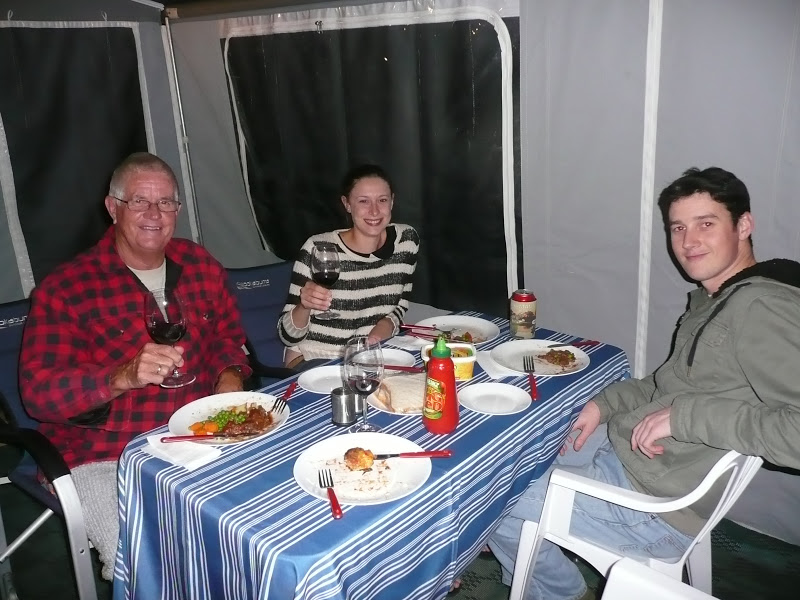


And the festivities continued the following day with the arrival of the Banninks.  After Hens and I engaged in a strenuous planning meeting


it was off to the camp kitchen where we cooked up a collective storm.


I had been planning for some time to use the Spanish mackerel backbone pieces we had been carrying with us since Kurrimine Beach as an entree to a meal.  Perfect opportunity.    Never having done these before, I was a touch nervous about the praises I had heaped on this fish.  I am pleased to report they were delicious...everyone had a great time picking the meat off the bones which left me free to occupy the BBQ plate cooking the main meal. (that's Dick with Bri and Stu)


As you may imagine, we did have a big night.  Stu had arranged a late start the following day which was probably just as well...he doesn't let his hair down too often, but when he does.....!


We were all still reasonably tidy at this stage (Troy, Hens, Hens' brother John, Stu and Bri and the camp clown in the background...Chris and Dick had wisely gone off to bed) but I must confess things went radically down hill when we repaired to the Bannink van for coffee, which would have been fine in itself but I should have remembered that Hens carries an extraordinary selection of liqueurs.  I mean, what reasonable person could possibly refuse the offer of a Drambuie with the brewed coffee? Or a second?  Needless to say our end of the park was not leaping about at dawn the next day!  The girls keep trying to impress on us that we are not the men we used to be....but one has to make the effort!

And just to complete the social whirl, we all toddled off later the following day to nearby Shellharbour where the Tansells were in camp in their van with a group of their friends.  At the Oceanview Hotel where we  had dinner, I came across the best trick I have ever found in a pub.  During happy hour, the prices of drinks are not reduced.  Rather, for all beers on tap which are ordered, one has the opportunity to toss a die with a call of odds or evens.  A correct call sees the drinks provided free!  Much better than winning a hand at poker.  Our luck held through our three pre-dinner rounds.  Best beer I have ever drunk.

We finally farewelled our friends and settled down to our last couple of days in Gerringong.  But not before we had all endured the worst weather Liz and I had experienced since taking to the road.  Thank goodness we had been forewarned by both the usual weather services, and, with more precise and expert predictions, the HMAS Albatross met men.  Annexes and awnings were all taken in and we hunkered down in the camp kitchen.  At 1830 hours it hit us.  We have never seen rain like it.  I am not sure how much dumped on Gerringong, but this same system drenched Ulladulla, some 80 kms south, with over 220 mils in less than six hours.  If ever we were looking to confirm that the van is well and truly waterproof, this was the acid test.  We passed with flying colours.  But more was to come.  By about 0500 hours the following morning the winds hit us.  Never had we been more pleased to now be living in a solid van rather than a pop top.  Forty knots gusting to sixty battered the camp for the next two hours before abating to a mere twenty which lasted for the rest of the morning.  Fortunately the severe low pressure system which had brought this misery moved off shore very rapidly.  The following day dawned warm and clear.  As they say, what a difference a day makes.  It was interesting to look around the park.....everyone was drying out and cleaning up.
File:816sqn crest.png


Luckily, this same day was that on which Stu had invited me out to the base to look over 816 Squadron, his new home.


I was a real thrill to finally get to see where the young Lieutenant struts his stuff.


Mind you, it is not all thrills and spills.  There is always the paperwork to be done.


But then there is the real thing!  Stu is currently flying the Sikorsky S-70B-2 Seahawk, a navy specific modified version of the Army's Blackhawk.  What a machine.  Its primary role is anti-submarine warfare but search and rescue and ship to ship and ship to shore transfers also fall within its role.  And I finally got to have a really good look at one!


I'll not bore you with all the details.  Suffice it to say that for an old stager like me who has been in and out of choppers of various sorts for the past thirty five years, this was a real highlight. And how nice it was, when chatting to Commander Grant O'Loughlan, Stu's CO, to be told that he is a real asset to the Squadron.  Navy chiefs are not known for false praise.

Back to Gerringong itself.  The whole Illawarra area, which stretches along the east coast from Woolongong in the north to well past Jarvis Bay in the south, is a real picture.  High mountain crests, green and wooded hills and valleys, rocky coastal headlands, rivers and creeks and sweeping white surf beaches, all complement each other to produce a scenic delight.


For us Geringong is a jewel in the area crown.  Mind you, as I mentioned previously, any walk around the town is not for the fainthearted.  The penalty paid for the magnificent views on offer in many areas of the town is the need to traverse the many hills on which the town is built. (this shot does not really do the slope of this road justice...it is steep)


For many, the main attraction of the town is Werri  Beach.  In summer, the caravan park, which has more on-site vans than we have ever seen anywhere else (over 200 of them!), is bedlam by all accounts.  As can be seen from this shot, the park is a mere hop step and jump from the beach.


Indisputably scenic as it is,  Werri Beach was, for me, somewhat one dimensional.  There is no doubt as to its attraction for surfers, but the steeply shelving nature of the beach itself, many rips and side sweeps in the surf which challenge all but the more competent swimmers, coupled with the fact that beach fishing is unrewarding, all serve to render Werri less than broadly user friendly.


Having said that, however, the local surf club is very active.  The nippers were hard at it on the day we were taking these shots.

The southern end of Werri Beach does provide a rock pool for those for whom the surf holds limited attraction


and a climb up the headland shows just how many of the houses in this part of Gerringong allow their occupants wonderful views over the beach and the Pacific beyond.


The top of the headland itself is given over to the local cemetery, as was often the case in towns settled at the time of Gerringong.  Imagine what this real estate would be worth today with its views south over the small boat harbour. 


Turning west from here, one looks down the eastern end of Belinda Street with its magnificent rows of pines


towards the intersection with Fern Street, the main drag.


 Like the rest of Gerringong, the main street climbs


and falls along its row of quite varied shops. 
 

As mentioned previously, we both love Gerringong and this part of the world generally, although our busy social calender did not allow for much local sightseeing on this trip apart from a quick look at Crookhaven Heads to the south.  Thanks Stu.

Now for those wondering about the adventures of the ship's cat and his impressions of Gerringong and the Werri Beach caravan park, let the pictures tell the story.


Max leave us in no doubt when he wants to attack the world at large.  He sits in the stair well and howls until he gets his way.


There was little doubt that Max was quite at home at Werri Beach.  He patrolled all over the park, on very rare occasions at the end of his lead held by your correspondent (there are just some things a man really shouldn't be seen doing!)


He spent hours lying in wait for the myriad of small lizards which made their home under the deck at the rear of our van.  They would pop out to sunbake throughout the day, and, much to the chagrin of the black panther, could retreat at twice the speed he could pounce.  Lizards 30 +, Max 0.  But then there were always trees to climb.


As you may have gathered, Gerringong was a highlight of our trip.  Marvellous surrounds, family and friends and, apart from the blow, delightful weather.  Even the storm was an adventure of sorts, a weather event to be worn as a badge of honour at subsequent happy hours!

And now the serious travelling starts.  Gundagai, Hay, Robinvale (from where this blog is coming), Berri, Tanunda and West Beach.  Our previous plans to take the van to Port Clinton for its 10,000 kms service (yes, we have travelled that far) en route to Adelaide have been altered for a number of reasons.  I shall complete the tale of our return trip once we have established ourselves at home.  Things are a touch too demanding during a series of one night stops to allow the time to blog.


Thursday, 11 October 2012

PORT STEPHENS - SYDNEY (4-6 OCTOBER)

It serves me right for tempting fate.  We had only been on the good old Pacific Highway out of Harrington for less than an hour when I commented to Liz how well the tug had been performing.  You guessed it....within no more than five minutes a very nasty warning light flashed up on the dashboard....potentially contaminated fuel!
 
Of course there was no where to pull over instantly, so whilst Liz scoured the owner's manual for information I was scouring the roadway for any sign to indicate a rest stop.  And the more Liz discovered, the more intently I was looking.  In essence the manual and another bit of blurb we were carrying relating to fuel all screamed warnings and advocated an immediate stop and consultation with "your nearest Toyota dealer".  I'm trying, I'm trying, was all I could think.
 
We eventually found a rest stop and thankfully same to a halt.  Then the real fun started.  The Australian wide dealer enquiry number is one of those damn voice activated things. Do you remember the advertisement where that poor girl who had just been involved in an accident was trying to convince the robotic voice at the other end of her insurance phone line that she was 'Moira' not 'moron'.?  Snap.  The variations of 'Bulahdelah' which came down the line when I was trying to confirm our present location had to be heard to be believed.  And, despite the odd name (or perhaps because of it), it is a quite well known highway location.
 
Our only other option was to manually enter a post code.  Now of course everyone on the road carries a post code book in their kit.....god bless her, Liz actually does! We finally confirmed that our nearest dealer was at Port Stephens, at this stage some 100 kms distant, and our destination for the day.
 
My real question was simple.  Could we safely continue? In desperation I had rung Jarvis Toyota in Adelaide only to be told that no-one in their service department was answering the phone.  This was just going from bad to worse.  So I then rang Port Stephens.  "Not a problem, sir, you can safely continue here and we'll happily replace the fuel filter (which had actually reached water saturation point) for you when you arrive". 
 
Relief!  And as if to make up for the earlier messing around, Jarvis Toyota in Adelaide responded and confirmed this advice.  Within another five minutes Liz also received a text message letting us know that our concerns had been registered and that someone would be in touch shortly.  No need...on our way again, finally rejoicing.  And just to add to the yarn, the local dealer in Port Stephens was a mere 200 metres from our caravan park entrance.  $100 later and we were all ship shape.
 
Our choice of parks in Port Stephens was virtually made for us in that none but one would take pets in school holidays.  As it was, we were delighted with 'The Bays'.  Apart from the coincidental fact that we were do close to the Toyota dealer, the park was open, well grassed and dotted liberally with magnificent shade trees. 


As we later discovered, the more fancied parks near the various waterfront areas of Port Stephens were absolutely chock-a-block with families enjoying the last week of the school holidays.  We were even more pleased with our particular camp.

Apart from the fact that PS lay a comfortable distance from Harrington, the main reason for this choice of destination lay in the fact that we were to catch up with the Hendersons, folk we had met in Townsville some months previously.  They had recently moved to the area from Sydney and proved to be wonderful local hosts.

In the course of arrival happy hour drinks and nibbles 'chez Marshies', Malcolm suggested a climb up Tomaree Head the following day to take in the view on offer.  He did point out  that it was something of a climb but would be worth it.  Having checked that I was still carrying my trusty knee bandages (my right knee is shot...bone on bone in parts and whilst it performs reasonably well on the flat, hills an stairs do present something of a challenge), we readily agreed to the plan. 

The following day dawned sunny and warm.  We were full of the enthusiasm which only touring generates....something new and spectacular to see.  Off we go.  And then we came fact to face with reality!


The higher of the two peaks on the headland on the left of this photo (taken a day later from another vantage point) was our climbing goal. A mere kilometre the signs said..but all uphill.


We did agree that the powers that be have done a magnificent job in providing stairs,


and some interestingly precipitous walkways to aid in the ascent.


Notwithstanding all the infrastructure to assist the adventurous, it was still a climb, but oh, so worth it!  Malcolm's assurances were anything but shallow. 

Port Stephens is indeed a very picturesque part of our country.  I have no trouble accepting as fact the claim that it holds more water than Sydney Harbour, particularly when looking across the waters of Nelson Bay to the north.


The views from the same spot at the top of the Head are equally inviting looking down


at the small, unnamed beaches which lie to the south of the headland. In fact, Port Stephens reminded us in a number of ways of some of the features of Magnetic Island.
 
 
This was especially the case when we reached the top of our climb to come across the remnants of a WW2 radar installation.   Large guns were apparently also placed high on Tomaree Head to protect the entrance to Port Stephens in a manner similar to the 'Forts' area of Maggie, and like those, they never fired a shot in anger.  We read with interest that the climb up to the radar station was so torturous that bunks were installed in the radar shack so as those who came off shift before daylight could have a kip before attempting the descent.  What staggered us was the effort it must have taken to build all this infrastructure in the first place.  No helicopter lift in those days!


A number of islands lie to the seaward side of the entrance to the bays.  It is past these that the numerous cruise boats (a couple of which can just be seen making passage back past the outer island) which make Port Stephens their home, ply their seasonal daily trade of transporting loads of hopefuls on the quest for whale sightings.


The entrance  to Port Stephens, which is really the name given to a collective of bays, inlets and peninsulas, is quite narrow, as can be seen in this shot looking north across to the northern headland and the coastal beaches beyond.


This feature of the area creates an interesting spectacle on the turn of the tide.  The massive volume of water of the incoming tide is squeezed between to the two headlands to create (well, for me at least...Liz couldn't seen anything to get excited about) a real surge which is so obvious from the vantage point of the top of Tomaree Head.


Of course, after the exertion of this adventure, drinks were clearly in order.  This need was very adequately met at one of Nelson Bay's beach side establishments which most conveniently puts on a a daily happy hour at just the time we arrived.   Mind you, I would hate to be buying the merely average bottles of bubbles at full tote odds!  But with such a delightful outlook, wonderful weather and good friends for company, the hell with the expence.


And the Port Stephens revelry did not stop there.  Sheelagh and Malcolm hosted us on a marvellous bayside picnic the following day.  Fish and chips sourced from a place of some renown at the quayside, complemented by an excellent green salad and washed down with a perfectly acceptable bubbles, provided the perfect way to end our sojourn in this lovely part of the world.


Reality and a return to the real world of travelling was soon upon us.  The following day dawned overcast and threatening and our trip along the Pacific Highway, past Newcastle and Gosford to our northern Sydney suburban destination of Dural was completed in fog and drizzle, and with the inevitable delay because of an accident.


Welcome to Sydney!  Fortunately we were only a part of this traffic snake for a few kilometres.  The park we had chosen for our overnight stay was quite close to our route around the northern and western suburbs which, apart from this section, we completed on motorways and freeways.  The convenience of these is well worth the toll payment, even at the obscene 'heavy vehicle' rate we were levied.


Next stop Picton and our good friends Sue and Pete Tansell who had graciously invited us to make use of their driveway and hospitality before we headed off further south to Gerringong. 


Thursday, 4 October 2012

HARRINGTON - CROWDY HEAD (1-2 OCTOBER)

With Max safely retrieved from his stint 'in jail', where, true to form he had reportedly been 'Mr Socialize' within the first two days of arrival (and put on weight), Liz did give him a sneaky little walk around the Sawtell park before we hitched up and headed out for Harrington.  Although the black panther still carries on a shade when in his basket in the tug, we have found that a pre-embarkation walk tends to to the trick.  Providing the road over which we are travelling is not inordinately rough, Max tends now to nod off within five minutes of hitting the track (I suspect he has some inbuilt survival mechanism....he was on borrowed time for a couple of the initial days......I think I may have mentioned previously that we nick named him Ultra Tune at one stage...that 'annoying noise in the back'!) 
 
Our choice of Harrington as our destination for the next two days was something of an act of faith.  Descriptions of it we had read in a caravan magazine all struck a chord.  Co-incidentally, a hearty endorsement of our choice was provided by a chap to whom we had chatted casually a few days before we left Sawtell.  He is a regular visitor and was effusive about the place, if, that is, one is looking for a small, somewhat off beat fishing town with unusual and often quite spectacular sea and river views.  Just the shot, we thought.
 
And, for once, our expectations were more than met.  Harrington is a delight.  Like many of these small towns on the Australian east coast, the approach to the 'old' town takes one through significant new development areas, obviously populated extensively by retirees (and indeed advertised as catering for them) on to the original township area.  It was here that our chosen park was situated, right in the main street.  'Chosen' is perhaps the wrong word...given that this park is the only one of the three in the town which takes pets, it was not really a matter of choice.  But, as those football commentators habitually parrot, "Luck's a fortune".  Our locale was ideal.  The park itself was small, populated heavily by permanents, and by many who obviously spend some months here fishing, fishing and fishing.
 
We did a quick foot recce once we had settled in.  The old pilot station memorial stands proudly atop a prominent hill at the eastern end of the main street. 
 
 
A scramble up the steep, grassy slope to the top provided a real reward.   From here one can gain a real view and understanding of the treacherous bar entrance to the Manning River beside which Harrington was established.
 
 
This shot shows the enormous breakwall built to protect the main river channel looking south from the hill.  The wall continues below the crest of the hill as can been seen here, looking east to the sea.


Harrington is another town (like Cardwell and Coffs Harbour) for which the cedar timber industry played a significant part in its foundation.  Stands of this much sought after timber grew along the Manning River. Because the only economical and practical way to transport this heavy, bulky, and relatively low value (per unit weight) product, was by ship, Harrington was established as a port for this purpose.  Maize and other farm produce was also transhipped from Harrington, as was locally mined limestone.  But the founding fathers did not properly account for, or perhaps foolishly ignored, the shifting sands of the river mouth. 

Even to this day, despite the construction of the massive breakwall which is almost four kilometres in length, the sands at the river mouth shift so constantly that is has never been possible to place lateral channel markers or entrance lead lights as guides to mariners.  One decent storm has the potential to cause a sand movement of such proportions as to render the position of markers obsolete. 
 
This problem was of a sufficient magnitude to see the establishment of the pilot station at Harrington in the late 1800's and the construction of the breakwall.  Notwithstanding the magnificent job the pilots did in navigating vessels over the bar, there were an astounding number of shipwrecks at the bar,  on the breakwall and elsewhere along this stretch of coast (more of this later).  As transport by ship was superseded and the cedar industry fell into decline, the use of pilots was no longer necessary and the service was abandoned as was the use of relatively large vessels in this area.

The breakwall does remain a real boon for the town, however.  Apart from the tourist attraction provided by walks along it, it is renown as a fishing platform (not that I had the time....this time...to indulge)


The old area of Harrington is quite small.  The short main street, here seen from pilot hill, meanders along the bank of the river and plays host to a number of beach type cafes and a variety of shops which provide for the necessities of holiday life.


The local hotel, originally named the Brighton Hotel, is also located on the main drag,


as is the huge local bowling club (here shown looking across the river from the breakwall), which, to our surprise, also owns the caravan park in which we stayed (strangely enough immediately opposite)


As is the case with the bowls club, the pub also looks out across the river and breakwall.  The tidal flows in the river are significant with a resultant constant variation in the exposure of the river flats and sandbars.  This provides an ever changing and wonderful vista whilst dining or drinking in either establishment, both of which are set up to take full advantage of the views on offer.

For those looking for something different, the large residential development on the approach to the old town includes a golf club country club and a large Irish pub. Our only thought was, "Why would you?", but I guess the locals do appreciate a change of scenery from time to time.  And I have to say there are some very fine houses in this area of the township, most of which are sited along channel developments off the Manning, which is itself a very large waterway, extending as most of these eastern seaboard rivers do, well inland.

A mere ten minute drive north of Harrington we made another real discovery.  Crowdy Head.  A gem!  This small town supports a local fishing industry of some vigour but is also home to one of the finest beaches we have discovered on this part of the coast.  On the day of our visit a howling south-easter was buffeting most of the coast, but here in this southern corner of the Crowdy Head bay, the surf was serenity itself.


The gently shelving beach arcs northwards for kilometre after kilometre.  At low tide it is wide and very user friendly for 4x4 vehicles which are permitted access.


The size of the Surf Club, which is situated at the southern end of the beach, is testament to its popularity.  We were told it is standing room only during the Christmas holidays and we could see why.  This really is a postcard place.


On the headland itself stands one of Australia's most unusual lighthouses.  Built in 1878,


this James Barnett designed lighthouse is one of only five in the country.  The others are all situated on this part of the coast at Fingal Head, the Richmond and Clarence Rivers and at Tacking Point.  The Crowdy Head light was built to provide support for those mariners making for the port of Harrington. 

Apart from the obvious charm of this lighthouse design, the thing which struck me most whilst visiting the headland was the historical data displayed on a nearby information board.

On it we were told that in the twenty three years between 1873 and 1896, 419 ships came to grief along the nearby coast and on the Harrington bar. What an astounding statistic.  I suspect that some of these were very small fishing smacks and the like, but nevertheless, this is maritime carnage of the highest order and served to remind me what a very different world it was then and what challenges the settlement of  this land or ours presented.

As well as visiting Crowdy Head, we drove to nearby Old Bar, the next coastal town south of Harrington.  For some unknown reason I have always wanted to see what this town has to offer.  In fact, if it had not been for the fact that the Old Bar caravan park does not cater for pets, this would have been our destination rather than Harrington. 

All I can say is that there are times when the travelling gods do smile down on the faithful. We were singularly unimpressed by the rocky beach, nondescript town centre and the foreshore area in general.  In fact a number of signs we saw in the foreshore park area indicated that the behaviour of many who make this part of the world their social oyster leaves much to be desired.  Saved!

And finally, one for Hens.  We found and visited Croki......and loved it!  One day old mate!

As I am sure you have now gathered, Harrington for us was one of the finds of the trip.  Like Iluka, where the non-pet policy stymied a return visit this trip, Harrington is totally lacking in pretension.  It fully lives up to its reputation as a quiet fishing town with much to offer in itself and nearby in terms of scenery, fishing, walking, beach activities generally and history.

Add to this the fact that the caravan park was populated by universally friendly and welcoming folk and you will understand why we left Harrington with real regret and the vow to return for at least three weeks or so in the future.

Port Stephens awaited, as did the first, and hopefully last, period of drama with the tug (apart, that is, from the broken windscreen near Mount Isa....how many months ago was that??)