Friday, 22 April 2016

WE MOVE TO MYRTLEFORD FOR THE FIRST TIME AND THE ARDERN'S CARAVAN PARK - (29 MARCH - 3 APRIL 2016)

Easter is over, thank God!  We are off to Myrtleford for some peace and quiet. Whilst we were still in Beechworth we had made the trip to Myrtleford after a visit to Yackandandah (I'll have to blog that town at some stage) and were very impressed with what we found. We decided that this would be an ideal base from which to visit many more places of interest in the Victorian north-east before heading north to our Mudgee rendezvous in late April.

A proper look at Bright (we had avoided it like the plague during the Easter mayhem), the town of Harrietville and the Buckland Valley to the south-east, and the King Valley and the Milawa food and wine region (including the iconic Brown Brothers) in the opposite direction, were all in our sights.

The autumn leaves had not yet really begun to turn and I was determined not to leave this general area until they had. But we had already arranged to stay with our good friends the Gangemis (of Kurrimine Beach acquaintance) at their holiday home in Yarrawonga as of 4 April, after which the nearby town of Rutherglen was on the agenda.  

All this meant that we had reached the conclusion that, unless it proved to be far less than satisfactory, we would make Myrtleford 'touring central' both before and after our sortie up to, and back from, the Murray River. I suspect this all sounds a little complicated, and to some extent it was something of a juggling act, but it worked for us. One of the really convenient things about this region is the fact that nothing is really too far from anything else.

So, with that rather convoluted explanation of our movements, let's at least get into Myrtleford and the Ardern's Caravan Park. There are two parks in Myrtleford. One is council owned, is quite large and, from what we could see, looked reasonable. The other is privately owned, is slightly more distant from the CBD (but still within easy walking distance), and appeared, from what we could find on the Internet, to be decidedly more rustic and appealing. 

And so it was.  We had made a good choice of both park and proprietors. Leissa and David, who bought this park about eighteen months ago when it was apparently in a shocking state, have been working like mad to bring it up to speed. The results of their efforts are obvious but by their own admission there is still much to be done.


As it was, from the moment we approached the entrance road off the main highway at the southern end of the Myrtleford CBD, we loved the place. At this point I must ask you to take note of the fact that Mount Buffalo can be seen very distinctly in the background. There is a reason for this which will become clear (or not) in a later blog. I pray your patience, dear readers.


Then entrance road into the park runs between a group of commercial premises which include a camping and fishing shop, ski hire 


and the famous Myrtleford Butter factory. We were very disappointed to later find that these premises are now used only to house a very expensive and second rate (as we were reliably informed by a local of good taste) cafe/restaurant.  All the butter making operation had been shifted to the town of Moyhu in the nearby King Valley. Our plan to stock up on what is reputed to be the best butter in the country fell flat.


But onwards to our digs.


Nearing the main entrance it was already apparent that this is a park where trees abound. What an arboreal archway this is.


As is required, we pulled up on the roadway and completed our arrival formalities at the building which combines the office and the owners' residence before Leissa walked me down to the site she had chosen for us. I was more than happy with her selection but it was made quite clear that I could occupy another if we would have preferred. We did use a different site on our second visit, but I'll explain that in due course.


For now it was a left turn and off into the park proper, again under the canopy of massive shade trees.


From here we drove past a row or two of 'annuals', of whom there a quite a few,


and down towards the levee bank at the rear of the park beyond which a small creek gurgles its way along to join the Ovens River. 


Another left turn onto the park 'back road' 


and a few more metres before here we were on site. This section of the park, being as shaded as it is (combined with the fact that there has been virtually no rain here for months) is not lush with grass underfoot, but we are well equipped to deal with dirt which was of no consequence when weighed against the size and 'elbow room' of our patch.


At this end of the park we virtually had the place to ourselves, which normally means that the amenities and camp facilities such as the BBQ's etc are miles away. Not so here at Ardern's.


For us it just got better and better. As this shot shows, we were a mere hop, step and a jump from a dual, completely self contained ablution facility and the adjacent BBQ.

When the camping area behind our site is heavily occupied, this might be something of a trial as folk queue for use (as apparently it was over Easter), but now it was like having our own private bathroom and toilet. At the end of this building you can see the stainless steel sink which I later put to very good use (I hate cleaning the Baby Q at the best of times, but even more so when fiddling about over a small sink...this was more than adequate)


The nearby BBQ facility was equally fit for purpose. It's not too often we find a hooded burner. 


So what else do we find at this delightful park? Let's toddle back to the front entrance where the main park ablution block can be seen down the roadway


which runs past the main group of park cabins and another community BBQ area.


On the end wall of this large building we found something we wish would be prominent in more caravan parks.....local maps. Although they are but an adjunct to those we carry with us, they are very useful to gain an early 'feel' for a new area.


Past the rear of the ablution block are the homes of a few more annuals,


whilst on the other side of the building is the short row of 'formal' slab sites for those who prefer this option (and who are short enough to fit).


The question we asked our selves, is why would you?  This is rustic camping of a high standard. Private nooks and crannies abound. 


Some choose to set up under the abundance of trees


whilst, for those wanting a little more sun (as we did on our return visit) there are many places available on this large, grassed 'oval' area.


Although this park supports quite a number of annuals, there are only two permanent residents, both of whom occupy very neat and well maintained little homes close to where we were in temporary residence. We actually got to know them both quite well in the time we were here (which can always be very useful for gaining all the local 'gen').


If I seem to be waxing somewhat lyrical about the Ardern's caravan park it is probably because it just fitted our bill to a 'T'. We had a wide, long site with oodles of space around us, plenty of shade (albeit not entirely necessary at this time of the year), complete peace and quiet and virtually our own bathroom and an outside kitchen. After the chaos and noise of a Porepunkah Easter, this was bliss.


And true to form, herself had no problem finding some afternoon sun in which to lounge on the unoccupied site opposite ours whilst yours truly indulged in my annoyingly obligatory afternoon snooze.


I think I have already mentioned we did make good use of the BBQ on several occasions.


Of course, close supervision was necessary just to make sure Chef Pierre remained on song. As you have probably gathered from these shots, the Ship's Cat was more than at home here. He even took on one of the permanent's dogs which foolishly came to visit and saw him off our site in short order in best 'black panther' tradition. Fortunately little 'Haggis' escaped with his nose intact, but Max huffed and puffed for a good ten minutes after his victory. What a difference a few years on the road makes!


And when we weren't sitting about the BBQ, 'happy hours' in the late afternoon under our awning were just that, particularly on this occasion when Liz was clearly delighted with her choice of sparkling red from the redoubtable Brown Brothers winery (which we had visited that morning). Oh, and yes, she does have other clothes!!


I shall have more to say about that sortie (to Brown Brothers) and many others we made from our wonderful base here at the Ardern's park in Myrtleford in my next few missives. The grass may have been growing in the park, but not under our feet!

Thursday, 21 April 2016

A WONDILIGONG WANDER (28 MARCH 2016)

During our five night stay at Porepunkah we were determined to get out and about the local area as much as possible. Apart from the fact this provided us with respite from the shrieking kids in the park, there really is a heck of a lot to see and do in this part of the world.

All the books and other tourist information we had been scouring through recommended a walk through Wondiligong, a tiny hamlet 6 kms due south of Bright. Why not, we thought. We had done the mountains bit, had no intention of going anywhere near Bright itself during the Easter mayhem other than in transit, and we did need a good walk. 

With all the driving we had been doing over the past few days, my back was playing up badly. I had initially injured it digging cockles on 1 February on the Goolwa beach, and things had not improved much since. I suspected an inflamed facet joint, and The Matron had finally had enough....."Just stop complaining and go and get some help."  Good advice....I had had enough of it too.

Fast forward a couple of weeks......and a visit to the Ovens Valley Physio services of Myrtleford and Bright. Marvellous folk. A thorough examination, a spot on diagnosis (I was right..inflamed facet joint and subsequent pain referral and spasms though the nearby large, deep seated QL muscle (which can really let one know if it is unhappy, believe me!). I left with a set of daily exercises which I must maintain for the next four to six weeks, and the prospect of relief after nearly three months of serious discomfort.

But back to late March and the need for a good walk (which I had found did provide some relief). 


Wandiligong it was to be and what a good decision this was. Off we drove, through Bright and out along the road which took us down into the Wandiligong Valley, nestled as it is between mountain ranges on both sides where the steep slopes carry a maze of fire and logging tracks though the extensive pine forests of this area.


The town is located on Morses Creek, where, like so many other places in this entire district, alluvial gold was discovered in the 1850's and the rush was on. In common with many other towns of this area during this period, Chinese immigrants formed a significant proportion of the gold mining population. More of this shortly.

Of course, the gold is now gone. Wandiligong, which once boasted a population of over 2,000, is currently home to 300 or so. The entire town is now registered with the National Trust of Australia as an 'historic landscape' (whatever that actually is!).  In the face of this registration I have to say I was expecting much more in the way of large and somewhat pretentious old buildings in the 'Beechworth' style, but this is not so in Wandiligong. This is a town of amuch more modest mien. In fact there are very few old stone constructions at all.


The jewel Wandiligong's historic buildings crown is the Manchester Unity Hall which rose in 1874. It, the old school and a couple of church buildings, which we'll see shortly, are about it for this type of construction.


We began our Wandiligong wander at a car park on Morses Creek, a tributary of the Ovens River, along the banks of which Wandiligong came into being during the gold rush. 


At this time of the year, and this year in particular, when the rain fall in the north-eastern Victoria has been well below average, this watercourse is anything but a raging torrent, but like so many of these streams which have their headwaters high in the Great Dividing Range, winter rains and snow melt change all that,


as this sign at a nearby bridge confirmed.


There are a number of defined walking trails around Wandiligong. Our choice took us initially down this track along Morses Creek


to the first real point of interest, one we were particularly keen to see. Our map was spot on.....here it is,


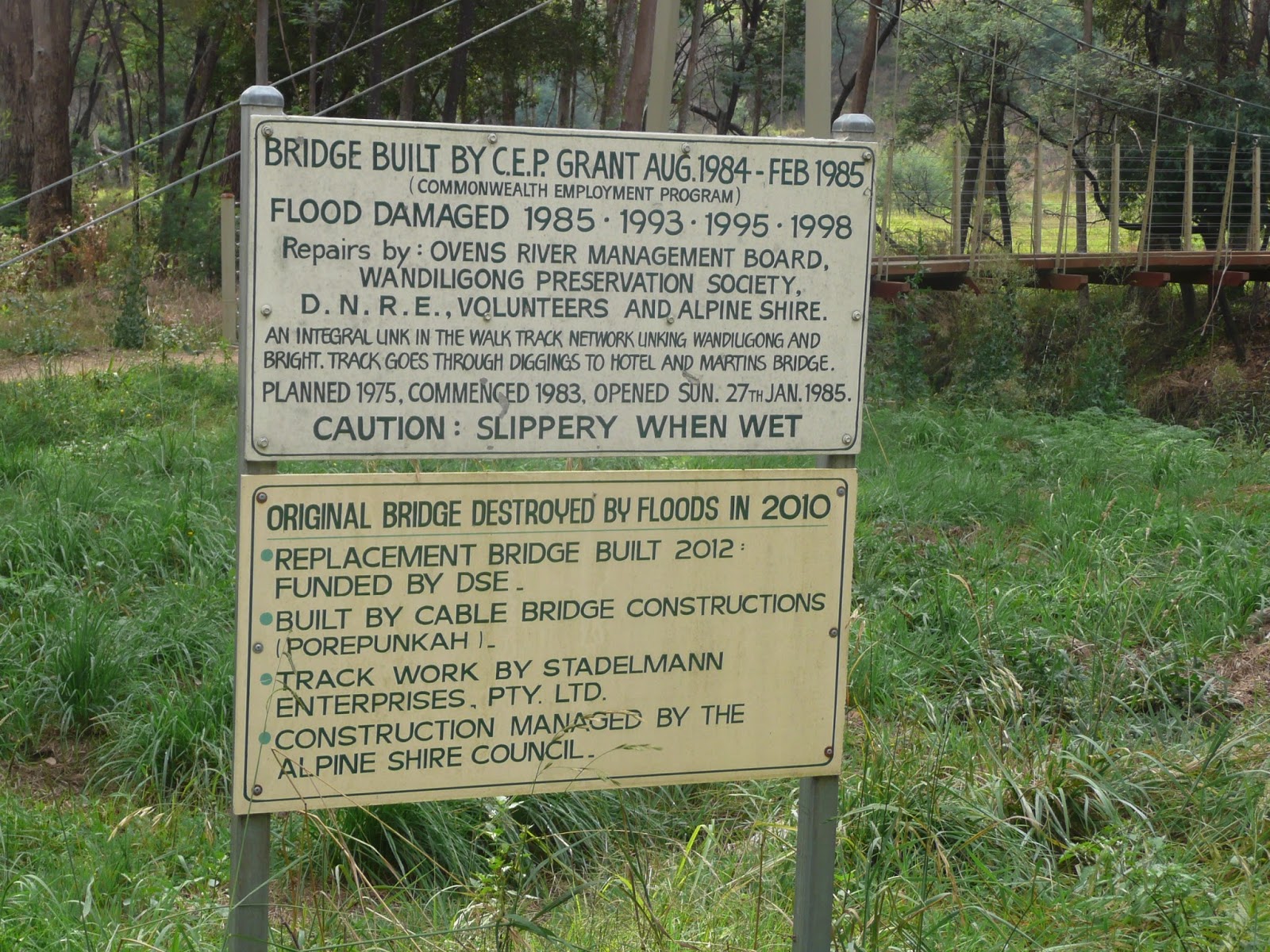
the historic Chinese swing bridge over the creek.


As I had alluded to previously, the Chinese population of this entire area during the mid 1850's and beyond, was significant. Whilst official records are scanty and of questionable accuracy, it is estimated that for ten years after 1861, over 500 Chinese were panning and digging along Morses Creek.

These numbers are sketchy, if for no other reason than the fact that in 1855 increasing concern about the numbers of Chinese arriving on this and most other Victorian gold fields had led the Victorian Government to impose at ten pounds 'arrival tax' for those coming off ships in Melbourne. 

Human nature being what it is, the Chinese were keen to avoid this impost. And here we have a connection with the Victorian gold fields and South Australia. In what I find to be an almost eerie parallel to the modern scourge of people smuggling, exploitative ship owners landed many would be oriental diggers at the coastal town of Robe in SA's south-east (for a passage fee of course). From here they would set off on foot across country for the gold fields. Their fee for passage usually included the services of a guide to lead them to Victoria, but in many instances these good and upright souls deserted their charges but a few days into the trek. 

The fact that so many Chinese emigres actually made it to the diggings is testament to their forbearance, tenacity and their highly developed sense of mutual support, but of course they were loath to make their presence officially known for obvious reasons. These traits were to eventually lead to many clashes between them and the Europeans, who became increasingly miffed by the fact that their ethnic rivals were actually doing much better than they were on the diggings and alluvial creeks, mainly for the reasons I've just outlined. 

In Wandiligong, the end result of gold dredging after the alluvial treasure ran out, and a series of major floods, have wiped out all but a few traces of the Chinese habitation of this area. The swing bridge (now obviously restored and maintained) is one which remains.


After crossing the creek we came to the second retained reminder of the Chinese of this area  This rather quaint metal hut


on the back wall of which is this striking mural, stands on the site of the 1800's Chinese joss house. Apart from the mural, decorative panels on the interior walls provide visitors with a quite detailed history of the activities and relationships of the Wandiligong Chinese.


From what I read it was the old, old story.....inter-ethnic intolerance seemed the norm, but woven through this principle standard of the social fabric were several instances of good and mutually beneficial working relationships between members of the two communities. 

But before I bore you to death with my particular fascination for this sort of stuff, let's get on with our walk. 


If anything was needed to lighten a ponderous reflection on the social events of the bygone era here in Wandiligong, this very smart little plaque on the front fence of a home quite near the joss house site did it in spades. How I would love to have a beer with these folk! I'm still chuckling as I type.


From the valley of Morses Creek we climbed back up onto the town's main street where a couple


of wooden buildings are about 'it' for the CBD.


Given its abundance it is not surprising that timber was the building material of choice for many of the houses as well. I've included this one on the main drag for two reasons..firstly because it is of a style common to this area, and secondly to later give some perspective of the slopes of this town (which it comes into view again).


The Wandiligong primary school is listed as one of the 'must see' buildings for all who take a jaunt around the village. To get there we had to climb yet again to the 'high side' of the main street, from where the vistas of the Wandiligong Valley came into clear view.


At this time of the year, when the winds are almost constantly calm (is that a contradiction in terms??), ultra-light aircraft, gliders and hang gliders take to the mountain air in surprising numbers. The views with which these intrepid folk must be rewarded as they float high above the valleys below can only be imagined. Mind you, not long after this particular day these activities became all but impossible....smoke filled the skies, but I'll have much (much) more to say about this later.


To our disappointment, the school building was all but hidden behind trees and renovation scaffolding, but we were able to gain some idea of what a grand structure this must have been in its day.


This shot, courtesy of the Victorian heritage council, gives a much clearer view (and this is not the entire building). Consistent with what we saw in Beechworth and elsewhere, it is obvious that the construction of large and quite grand buildings to accommodate the local students of the era was of considerable official importance.


The school building is located on a road well above the main street, a road which our visitor's map suggested would take us down to the area known as 'police paddocks'.


We set off, and could soon see down to the main street, and the old house which featured earlier.


A little further along this road we passed another of the few brick buildings in Wandiligong, (another under renovation) one of  the local churches.


This high side of the town is is obviously a 'knob hill' of sorts. We walked past a number of beautiful homes and gardens, 


and, not surprisingly, tucked away amongst the many trees, charming little bed and breakfast cottages 


of which these are but two examples.


Beyond 'holiday central' the road petered out and the trail became decidedly rustic. We could but hope we were still on the right path


as we wandered down past the back yards of several houses fronting on to the street below, all but hidden behind screens of trees and creepers.


Our descent took us back onto one of the main roads of this small township, lined as most are with magnificent stands of trees, some of which were just beginning to show the first blush of autumn colours.


This sign certainly attracted our attention, if for no other reason than that we were not entirely sure where the park itself actually was. It is not listed in our parks book.


Time prevented further enquiries, and as we made our way across the open fields on the opposite side of the road, we came to the conclusion that this is a park which probably offers open, rustic, unpowered camping for those so inclined in what is certainly a beautiful setting.


With another small creek crossing completed


we found ourselves on a track leading up to Wandiligong's Mountain View Hotel. On the day of our first visit here, it was almost impossible to see the low pub building behind the massed row of vehicles along the front. The Easter holiday crowd had obviously descended in numbers on this well publicised watering hole.


I've included this shot we took on a later visit to give a better view of this small but apparently prestigious establishment.


With no thought to a thirst quenching ale.......well, that's not quite true.....I did give it considerable thought, views which were firmly rebuffed when put into words (how can a such a refined woman as my wonderful travelling companion make the words "I thought you were trying to lose weight" sound so withering?)....we continued our merry way back towards the track along Morses Creek.


Again our route was lined with splendid trees, many of which we discovered were chestnuts of different shapes 


and sizes. These can be majestic trees indeed, and abound in this area. The commercial production of both these and walnuts forms a significant part of the local economy.


And at this point I must confess to having learnt a painful lesson about chestnuts, a nut of which I knew very little (until now) and one about I am now very much the wiser on many fronts. 


The nut itself is housed in what appears to be a 'fluffy' cocoon which bursts open when the fruit drops from the tree. How interesting, I thought, and without giving it any further heed, I picked one up. Serious, serious mistake!!  This innocuous looking covering is akin to a flora version of a porcupine....needle sharp spines which penetrate the skin of the unwary at the slightest touch and deliver a most unwarranted sting.


And believe, me the sting persists for ages (well so it seemed to me, for whom the ongoing pain was a case of not adding 'insult to injury' but rather injury to ignorance.)  I later saw some locals harvesting nuts in their front yard. It came as no surprise to note that, as they crawled about beneath the tree of bounty scooping its fallen fruits into their dilly bags, they were not only wearing very heavy duty gloves, but equally sturdy knee coverings. I came away from Wandiligong with a very healthy respect for chestnuts in the raw!  For the ill-equipped they are to be treated with the same respect as a rearing snake.


By now we were well into the return leg of our ramble of over an hour. We crossed Morses Creek yet again,


and had begun to follow its course back to our parking area when we came across this small hut like building on the trail....a bird hide which provides cover and concealment for the local 'twitchers'.


But a short distance further along the well defined walking track, we had a delightful ornithological experience of our own, which just served to confirm that the bird hide had not merely been built on hope.


The still of the country morning was suddenly rent asunder by the shrieks and chattering  of a  flock of parrots which swirled around us as they swooped on their chosen feeding ground and began to chomp away, quite unafraid of our presence.


There were dozens of them, constantly chattering and constantly busy. 


Instant identification escaped us, so once back at base, out came our much thumbed through and somewhat battered 'Field Guide to Australian Birds'. We have reached the conclusion that these were all Australian King parrots, but oddly, the entire flock was female. The male displays a completely red breast of a much brighter hue, but this must have been, literally, 'a hens' party'.


So, with a final glimpse of the Chinese swing bridge through the bush, we returned to our trusty Cruiser and drove out beyond the township on a purchasing mission.


The Wandiligong Valley is home to one of the largest apple orchards in the Southern Hemisphere, and we had just munched our way through the marvellous product of the Snowline orchards of Stanley. 'When in Rome' was very much in our thoughts, and as I am sure you will appreciate, fruit freshly picked bears no comparison to the waxed and pampered cold store product which features on most supermarket shelves.


The Nightingale family is the largest producer in this valley and their retail shed is testament to this fact.


Set as it is on the main road south of Wandiligong and surrounded on all sides by orchard trees and gardens, against the backdrop of the Alpine slopes and ridges, this promises a shopping experience from the outset.


And so it is. Here apples of all varieties are on sale in bulk (and all, sensibly at a standard price per kilo irrespective of type)


or pre-packaged.


But that's not all folks. Seasonal produce of all kinds is displayed on the shelves of this large cold room,  


in addition to a mind boggling selection of bottled jams, chutneys, sauces, souvenirs and other assorted goodies all laid out to tempt the tourist to make an unplanned purchase.  Not us...we are hardened travellers, impervious to the Siren like call of even the most tempting display (unless it happens to be a stubby holder!)


Apart from a range of apples and some other fruit and veggies, I did buy a kilo of chestnuts. After having been painfully set upon by one of these nuts, I was determined to seek my revenge by roasting and eating a few of its brethren, where again this fractious nut almost gained the upper hand.  But that's a tale for another day!

For now, it was farewell Wandiligong.  We are still not entirely sure what defines an 'historic landscape', but whatever it may be we were happy indeed to have taken the time to have gained some much needed exercise in this picturesque little town.